Our mission is to help computational modelers develop, document, and share their computational models in accordance with community standards and good open science and software engineering practices. Model authors can publish their model source code in the Computational Model Library with narrative documentation as well as metadata that supports open science and emerging norms that facilitate software citation, computational reproducibility / frictionless reuse, and interoperability. Model authors can also request private peer review of their computational models. Models that pass peer review receive a DOI once published.
All users of models published in the library must cite model authors when they use and benefit from their code.
Please check out our model publishing tutorial and feel free to contact us if you have any questions or concerns about publishing your model(s) in the Computational Model Library.
Displaying 10 of 1138 results for "A Flache" clear search
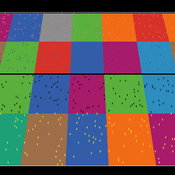
Relational Social Interaction Model of Migration (RSIMM)
Christopher Roberts Sean Bergin | Published Monday, February 07, 2011 | Last modified Saturday, April 27, 2013Current trends suggest that when individuals of different cultural backgrounds encounter one another, their social categories become entangled and create new hybridized or creole identities.
Hohokam Water Management Simulation (HWM)
John Murphy | Published Wednesday, August 31, 2011 | Last modified Saturday, April 27, 2013Simulation of irrigation system management using archaeological data from southern Arizona
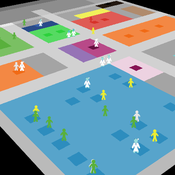
ED simulation
Emilio Sulis | Published Sunday, October 15, 2017The functioning of an hospital ED. The use case concerns an hospital in Italy which is moving in a new building. Simulations interest both new and old department, to investigate changes by exploring KPIs.
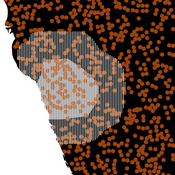
FoxNet is an individual-based modelling framework that can be customised to generate high-resolution red fox Vulpes vulpes population models for both northern and southern hemispheres. FoxNet predicts red fox population dynamics, including responses to control and landscape productivity. Model landscapes (up to ~15,000 km^2 and bait layouts can be generated within FoxNet or imported as GIS layers.
If you use FoxNet, please cite:
Hradsky BA, Kelly L, Robley A, Wintle BA (in review). FoxNet: an individual-based modelling framework to support red fox management. Journal of Applied Ecology.
CoComForest
Wuthiwong WIMOLSAKCHAROEN | Published Tuesday, February 02, 2021The name of the model, CoComForest, stands for COllaborative COMmunity FOREST management. The purposes of this model are to expose local resource harvesters to the competition with external resource harvesters, called outsiders, and to provide them the opportunity to collectively discuss on resource management. The model, which is made of a set of interconnected entities, including (i) community forest habitat, (ii) resource harvesters, (iii) market, and (iv) firebreak. More details about the CoComForest model are described based on the Overview, Design concept, and Details (ODD) protocol uploaded with the model.
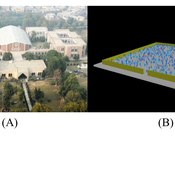
Individual Heights and Phase Transition under Emergences: Agent-Based Modeling from 2D to 3D
zhuo zhang | Published Saturday, August 27, 2022We use an agent-based 3D model to reveal the behavioral dynamics of real-world cases. The target of the simulation is the Peshawar massacre. The previous 2-D model has three main problems which can be solved by our 3-D model. Under the key action rules, our model matches the real target case exactly. Based on the optimal solution, we precisely match the results of the real cases, such as the number of deaths and injuries. We also explore the importance of adding height (constructed as a 3D model) to the model.
Peer reviewed Gradient Descent Simulation
Ilyes Azouani | Published Wednesday, March 18, 2026 | Last modified Monday, May 25, 2026This model visualizes gradient descent optimization - the fundamental algorithm used to train neural networks and other machine learning models. Agents represent different optimization algorithms searching for the minimum of a loss landscape (the “error surface” that ML models try to minimize during training).
The model demonstrates how different optimizer types (SGD, Momentum with different parameters) behave on various loss landscapes, from simple bowls to the notoriously difficult Rosenbrock “banana valley” function. This helps build intuition about why certain optimization algorithms work better than others for different problem geometries.
HOW IT WORKS
…
Modelling Electricity Consumption in Office Buildings: An Agent Based Approach
Tao Zhang | Published Thursday, May 19, 2011 | Last modified Saturday, April 27, 2013This is the electronic companion to the paper “Modelling Electricity Consumption in Office Buildings: An Agent Based Approach”
The effect of error on cultural transmission
Claudine Gravel-Miguel | Published Thursday, November 01, 2012 | Last modified Saturday, April 27, 2013This is the replication of the experiment performed by Eerkens and Lipo (2005) to look at the effect of copying errors when specific traits are transferred from an individual to another.
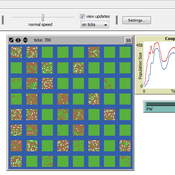
The Evolution of Cooperation in an Ecological Context
Oyita Udiani | Published Saturday, November 03, 2012 | Last modified Saturday, April 27, 2013This is a replication of the altruistic trait selection model described in Pepper & Smuts (2000, 2002).
Displaying 10 of 1138 results for "A Flache" clear search