Our mission is to help computational modelers develop, document, and share their computational models in accordance with community standards and good open science and software engineering practices. Model authors can publish their model source code in the Computational Model Library with narrative documentation as well as metadata that supports open science and emerging norms that facilitate software citation, computational reproducibility / frictionless reuse, and interoperability. Model authors can also request private peer review of their computational models. Models that pass peer review receive a DOI once published.
All users of models published in the library must cite model authors when they use and benefit from their code.
Please check out our model publishing tutorial and feel free to contact us if you have any questions or concerns about publishing your model(s) in the Computational Model Library.
Displaying 10 of 1195 results for "Aad Kessler" clear search

BehaviorSpace tutorial model
Colin Wren | Published Wednesday, March 23, 2016This is based off my previous Profiler tutorial model, but with an added tutorial on converting it into a model usable with BehaviorSpace, and creating a BehaviorSpace experiment.
A discrete-time stochastic model with state-dependent transmission probabilities and multi-agent simulations focusing on possible risks that could materialize in the final phase of the epidemic.
Peer reviewed BAM: The Bottom-up Adaptive Macroeconomics Model
Alejandro Platas López Alejandro Guerra-Hernández | Published Tuesday, January 14, 2020 | Last modified Sunday, July 26, 2020Overview
Purpose
Modeling an economy with stable macro signals, that works as a benchmark for studying the effects of the agent activities, e.g. extortion, at the service of the elaboration of public policies..
…
MarPEM: An Agent Based Model to Explore the Effects of Policy Instruments on the Transition of the Maritime Fuel System
G Bas I Nikolic K De Boo Am Vaes - Van De Hulsbeek | Published Thursday, June 15, 2017MarPEM is an agent-based model that can be used to study the effects of policy instruments on the transition away from HFO.
An agent based model of a population subject to floods
Bruno Bonté Katrin Erdlenbruch | Published Wednesday, September 22, 2021This model allows simulating the impacts of floods on a population. Floods are described by their intensity (flood height) and date of occurrence. Households are more or less severely hit by floods according to their geographical situation. Impacts are measured in terms of reductions in household wealth. Households may take up protection measures against floods, depending on their individual characteristics, a social network and information campaigns. If such measures are taken, flood impacts (wealth reduction) are less severe. Information campaigns increase the probability that households adopt protection measures. Two types of information campaigns are modeled: top-down policies which are the same for all households, people-centered policies, which adapt to the individual characteristics of each household.
University Connectivity
Rachel Wozniak Nick Glover Chris English Juan Cisneros | Published Tuesday, November 30, 2021This model is designed to show the effects of personality types and student organizations have on ones chance to making friendships in a university setting. As known from psychology studies, those that are extroverted have an easier chance making friendships in comparison to those that are introverted.
Once every tick a pair of students (nodes) will be randomly selected they will then have the chance to either be come friends or not (create an edge or not) based on their personality type (you are able to change what the effect of each personality is) and whether or not they are in the same club (you can change this value) then the model triggers the next tick cycle to begin.
Agent-based Modeling of Evolving Intergovernmental Networks
Sungho Lee | Published Thursday, January 29, 2009 | Last modified Saturday, April 27, 2013This agent-based model using ‘Blanche’ software provides policy-makers with a simulation-based demonstration illustrating how autonomous agents network and operate complementary systems in a decentral
Diffusion of Eco-Innovation through Inter-firm Network Targeting: An Agent-Based Model
apyka Flaminio Squazzoni Shyaam Ramkumar Matthias Mueller | Published Monday, January 10, 2022This model is developed as a theoretical agent-based model to study the general phenomena of network-based targeting strategies on eco-innovation adoption and diffusion through inter-firm networks.
Peer reviewed INOvPOP
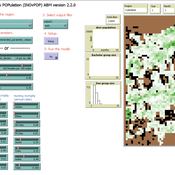
Aniruddha Belsare | Published Wednesday, June 01, 2022 | Last modified Wednesday, July 10, 2024INOvPOP is designed to simulate population dynamics (abundance, sex-age composition and distribution in the landscape) of white-tailed deer (Odocoileus virginianus) for selected Indiana counties. Updated for netLogo 6.4.0
CPNorm
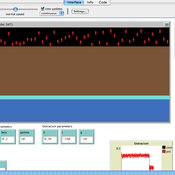
Ruth Meyer | Published Sunday, June 04, 2017 | Last modified Tuesday, June 13, 2017CPNorm is a model of a community of harvesters using a common pool resource where adhering to the optimal extraction level has become a social norm. The model can be used to explore the robustness of norm-driven cooperation in the commons.
Displaying 10 of 1195 results for "Aad Kessler" clear search