Our mission is to help computational modelers develop, document, and share their computational models in accordance with community standards and good open science and software engineering practices. Model authors can publish their model source code in the Computational Model Library with narrative documentation as well as metadata that supports open science and emerging norms that facilitate software citation, computational reproducibility / frictionless reuse, and interoperability. Model authors can also request private peer review of their computational models. Models that pass peer review receive a DOI once published.
All users of models published in the library must cite model authors when they use and benefit from their code.
Please check out our model publishing tutorial and feel free to contact us if you have any questions or concerns about publishing your model(s) in the Computational Model Library.
Displaying 10 of 1234 results for "Lee-Ann Sutherland" clear search
Diffusion of Vegetarian Diet
Patrick Taillandier Nicolas Salliou Rallou Thomopoulos | Published Monday, April 29, 2019Model of diffusion of vegetarian diets coupling ABM and argumentation framework
AgriAdopt
Sebastian Rasch | Published Tuesday, March 26, 2024The purpose of this model is to project the dynamics of technology adoption of autonomous weeding robots by sugar beet producing farmers in North Rhine-Westphalia (NRW). Moreover, the design of the model serves the purpose to investigate second-order effects of robot adoption on shifts in farm income and on production quantities of main crops produced in North Rhine-Westphalia. One aim is to analyse the impact of technology attributes and costs of pesticides on adoption patterns.
Simulation Software for Random-Subset Voting
Guilherme Amorim | Published Friday, August 02, 2019Simulation Software for Random-Subset Voting with Borda, approval, plurality and Condorcet.
Setting the Stage for Inequality
Timothy Dennehy | Published Monday, March 11, 2013 | Last modified Saturday, April 27, 2013How can a strictly egalitarian social system give way to a stratified society if all of its members punish each other for any type of selfish behavior? This model examines the role of prestige bias in constant and variable environments on the development of hierarchies of wealth.
Spatio-Temporal Dynamic of Risk Model
J Jumadi | Published Tuesday, October 22, 2019 | Last modified Sunday, January 05, 2020This model aims to simlulate the dynamic of risk over time and space.
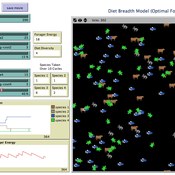
Diet breadth model from Optimal Foraging Theory (Human Behavioral Ecology)
C Michael Barton | Published Wednesday, November 26, 2008 | Last modified Thursday, March 12, 2015Diet breadth is a classic optimal foraging theory (OFT) model from human behavioral ecology (HBE). Different resources, ranked according to their food value and processing costs, are distributed in th
Simulation software for Random-Subset Voting
Guilherme Amorim | Published Friday, August 02, 2019This software simulates the Random-Subset Voting method for Borda, plurality, approval and Condorcet.

Biodynamica
Klaus Jaffe | Published Saturday, December 24, 2016Agent based simulation model for the study of the genetic evolution of sexual recombination and social behavior
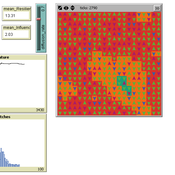
SpeciesWorld
Tony Lawson | Published Friday, March 16, 2012 | Last modified Saturday, April 27, 2013How can species evolve a cooperative network to keep the environment suitable for life?
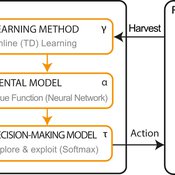
LBD Model: Learning-by-doing for sustainable management of renewable resources
Emilie Lindkvist Örjan Ekeberg Jon Norberg | Published Thursday, March 09, 2017This is a simulation model of an intelligent agent that has the objective to learn sustainable management of a renewable resource, such as a fish stock.
Displaying 10 of 1234 results for "Lee-Ann Sutherland" clear search