Our mission is to help computational modelers develop, document, and share their computational models in accordance with community standards and good open science and software engineering practices. Model authors can publish their model source code in the Computational Model Library with narrative documentation as well as metadata that supports open science and emerging norms that facilitate software citation, computational reproducibility / frictionless reuse, and interoperability. Model authors can also request private peer review of their computational models. Models that pass peer review receive a DOI once published.
All users of models published in the library must cite model authors when they use and benefit from their code.
Please check out our model publishing tutorial and feel free to contact us if you have any questions or concerns about publishing your model(s) in the Computational Model Library.
Displaying 7 of 117 results Python clear search
Activation Regimes in Opinion Dynamics
Meysam Alizadeh Claudio Cioffi-Revilla | Published Tuesday, September 01, 2015We compare the effect of four activation regimes by measuring the appropriate opinion clustering statistics and also the number of emergent extremists.

MedLanD Modeling Laboratory
C Michael Barton Sean Bergin Isaac Ullah Gary Mayer Hessam Sarjoughian Helena Mitasova | Published Friday, May 08, 2015 | Last modified Thursday, December 14, 2017The MML is a hybrid modeling environment that couples an agent-based model of small-holder agropastoral households and a cellular landscape evolution model that simulates changes in erosion/deposition, soils, and vegetation.
Parental choices, children's skills, and skill inequality: An agent-based model implemented in Python
Andrés Cardona | Published Thursday, October 30, 2014The model explores the emergence of inequality in cognitive and socio-emotional skills at the societal level within and across generations that results from differences in parental investment behavior during childhood and adolescence.
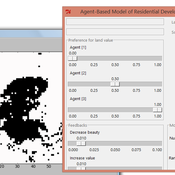
IDEAL
Arika Ligmann-Zielinska | Published Thursday, August 07, 2014IDEAL: Agent-Based Model of Residential Land Use Change where the choice of new residential development in based on the Ideal-point decision rule.
Land Use in the Chitwan Valley
Alex Zvoleff | Published Monday, June 02, 2014chitwanabm is a spatially explicit agent-based model of population and land use in the Chitwan Valley, Nepal, designed to explore feedbacks between population and environment, with a heavy focus on community context and individual-level variation.
Opinion Dynamics Under Intergroup Conflict Escalation
Meysam Alizadeh Alin Coman Michael Lewis Katia Sycara | Published Friday, March 14, 2014 | Last modified Wednesday, October 29, 2014We develop an agent-based model to explore the effect of perceived intergroup conflict escalation on the number of extremists. The proposed model builds on the 2D bounded confidence model proposed by Huet et al (2008).
Stationarity Test
Jakob Grazzini | Published Monday, November 29, 2010 | Last modified Saturday, April 27, 2013This is a stationarity test, it tests whether a given moment is constant during the time series (null hypothesis). The Wald Wolfowitz nonparametric fitness test is applied to time series.
Displaying 7 of 117 results Python clear search