Our mission is to help computational modelers develop, document, and share their computational models in accordance with community standards and good open science and software engineering practices. Model authors can publish their model source code in the Computational Model Library with narrative documentation as well as metadata that supports open science and emerging norms that facilitate software citation, computational reproducibility / frictionless reuse, and interoperability. Model authors can also request private peer review of their computational models. Models that pass peer review receive a DOI once published.
All users of models published in the library must cite model authors when they use and benefit from their code.
Please check out our model publishing tutorial and feel free to contact us if you have any questions or concerns about publishing your model(s) in the Computational Model Library.
Displaying 10 of 1137 results for "Elena A. Pearce" clear search
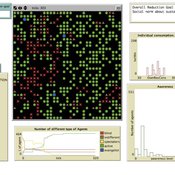
Peer reviewed A model of environmental awareness spread and its effect in resource consumption reduction
Giovanna Sissa | Published Sunday, June 21, 2015 | Last modified Monday, August 17, 2015The model reproduces the spread of environmental awareness among agents and the impact of awareness level of the agents on the consumption of a resource, like energy. An agent is a household with a set of available advanced smart metering functions.
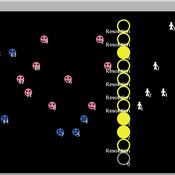
Peer reviewed Garbage can model NetLogo implementation
Smarzhevskiy Ivan | Published Sunday, February 14, 2016 | Last modified Tuesday, July 30, 2019It is NetLogo reconstruction of the original FORTRAN code of the classical M. Cohen, J. March, and J. Olsen “garbage can model” (GCM or CMO) of collective decision-making.
The Effects of Fiscal Targets in a Currency Union: a Multi-Country Agent Based-Stock Flow Consistent Model
Ermanno Catullo Alessandro Caiani Mauro Gallegati | Published Saturday, March 11, 2017We present an Agent-Based Stock Flow Consistent Multi-Country model of a Currency Union to analyze the impact of changes in the fiscal regimes that is permanent changes in the deficit-to-GDP targets that governments commit to comply.
Food Safety Inspection Model - Random Strategy
Sara Mcphee-Knowles | Published Wednesday, March 05, 2014 | Last modified Monday, April 08, 2019The Inspection Model represents a basic food safety system where inspectors, consumers and stores interact. The purpose of the model is to provide insight into an optimal level of inspectors in a food system by comparing three search strategies.
Food Safety Inspection Model - Stores Signal with Errors
Sara Mcphee-Knowles | Published Wednesday, March 05, 2014 | Last modified Monday, April 08, 2019The Inspection Model represents a basic food safety system where inspectors, consumers and stores interact. The purpose of the model is to provide insight into an optimal level of inspectors in a food system by comparing three search strategies.
Food Safety Inspection Model - Stores Signal
Sara Mcphee-Knowles | Published Wednesday, March 05, 2014 | Last modified Monday, August 26, 2019The Inspection Model represents a basic food safety system where inspectors, consumers and stores interact. The purpose of the model is to provide insight into an optimal level of inspectors in a food system by comparing three search strategies.
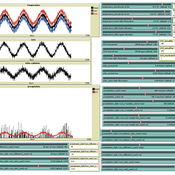
Peer reviewed The Indus Village's Weather model: procedural generation of daily weather
Andreas Angourakis | Published Tuesday, May 13, 2025Overview
The Weather model is a procedural generation model designed to create realistic daily weather data for socioecological simulations. It generates synthetic weather time series for solar radiation, temperature, and precipitation using algorithms based on sinusoidal and double logistic functions. The model incorporates stochastic variation to mimic unpredictable weather patterns and aims to provide realistic yet flexible weather inputs for exploring diverse climate scenarios.
The Weather model can be used independently or integrated into larger models, providing realistic weather patterns without extensive coding or data collection. It can be customized to meet specific requirements, enabling users to gain a better understanding of the underlying mechanisms and have greater confidence in their applications.
…
A Replication of Rolf Zieglers Kula Ring Simulation
Rhian Stotts | Published Tuesday, December 16, 2008 | Last modified Saturday, April 27, 2013This model is a simulation of the ceremonial exchange network in Papua New Guinea called the Kula Ring. In the Kula Ring, there are two types of gifts that travel in opposite directions: armshells co
A simulation of the structure of academic science
Nigel Gilbert | Published Friday, December 31, 2010 | Last modified Saturday, April 27, 2013This is a re-implementation of the model described in Gilbert, Nigel. (1997). A simulation of the structure of academic science. Sociological Research Online, 2(2)3, http://www.socresonline.org.uk/
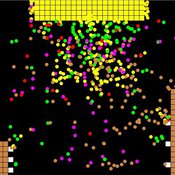
CROSS - crowd behaviour modelling: a festival crowd model
Nanda Wijermans | Published Monday, February 14, 2011 | Last modified Saturday, April 27, 2013CROwd Simulation of Situated individuals represents a modern generation simulation as a (social) scientific tool for understanding crowd behaviour. The CROSS model represents individuals in a crowd as social-cognitive agents that are affected by their social and physical surroundings and produce behaviour and behaviour patterns.
Displaying 10 of 1137 results for "Elena A. Pearce" clear search