Our mission is to help computational modelers develop, document, and share their computational models in accordance with community standards and good open science and software engineering practices. Model authors can publish their model source code in the Computational Model Library with narrative documentation as well as metadata that supports open science and emerging norms that facilitate software citation, computational reproducibility / frictionless reuse, and interoperability. Model authors can also request private peer review of their computational models. Models that pass peer review receive a DOI once published.
All users of models published in the library must cite model authors when they use and benefit from their code.
Please check out our model publishing tutorial and feel free to contact us if you have any questions or concerns about publishing your model(s) in the Computational Model Library.
Displaying 10 of 994 results for "Dave van Wees" clear search
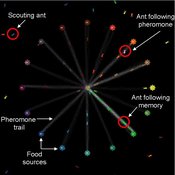
Composite Collective Decision Making - ant colony foraging model
Tomer Czaczkes Benjamin I Czaczkes | Published Thursday, December 17, 2015The model explores how two types of information - social (in the form of pheromone trails) and private (in the form of route memories) affect ant colony level foraging in a variable enviroment.
Change and Senescence
André Martins | Published Tuesday, November 10, 2020Agers and non-agers agent compete over a spatial landscape. When two agents occupy the same grid, who will survive is decided by a random draw where chances of survival are proportional to fitness. Agents have offspring each time step who are born at a distance b from the parent agent and the offpring inherits their genetic fitness plus a random term. Genetic fitness decreases with time, representing environmental change but effective non-inheritable fitness can increase as animals learn and get bigger.
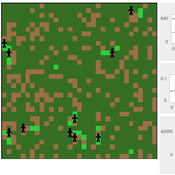
Forest Logging and Ecosystem Degradation
Carla Guerrero | Published Sunday, February 15, 2026This model simulates a forest ecosystem affected by human logging. We explore different kind of approaches and their possible consequences for the ecosystem. Loggers can either be responsible or irresponsible, they will either take care to cut trees or not. In turn their actions will have consequences on the quality of the soil, the atmosphere as well as their profit made from logging. In this model we see that even careful management cannot prevent the degradation of the forest ecosystem.

Autonomy or control? An agent-based study of self-organising versus centralised task allocation
Shaoni Wang | Published Wednesday, January 29, 2025The aim of our model is to investigate the team dynamics through two types of task allocation strategies, with a focus on the dynamic interplay between individual needs and group performance. To achieve this goal, we have formulated an agent-based model (ABM) to formalize Deci & Ryan’s self-determination theory (SDT) and explore the social dynamics that govern the relationship between individual and group levels of team performance.
Social and Task Interdependencies in Innovation Implementation
Spiro Maroulis Uri Wilensky | Published Tuesday, June 04, 2013 | Last modified Tuesday, March 04, 2014This is a model of innovation implementation inside an organization. It characterizes an innovation as a set of distributed and technically interdependent tasks performed by a number of different and socially interconnected frontline workers.
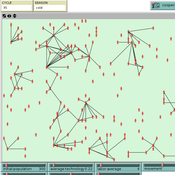
PSMED - Patagonia Simple Model of Ethnic Differentiation
Xavier Vilà Joan A Barceló J A Cuesta Florencia Del Castillo Ricardo Del Olmo José M Galán Laura Mameli Francisco J Miguel David Poza José I Santos | Published Tuesday, December 10, 2013Patagonia PSMED is an agent-based model designed to study a simple case of Evolution of Ethnic Differentiation. It replicates how can hunter-gatherer societies evolve and built cultural identities as a consequence of the way they interacted.
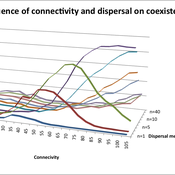
Varying effects of connectivity and dispersal on interacting species dynamics
Kehinde Salau | Published Monday, August 29, 2011 | Last modified Saturday, April 27, 2013An agent-based model of species interaction on fragmented landscape is developed to address the question, how do population levels of predators and prey react with respect to changes in the patch connectivity as well as changes in the sharpness of threshold dispersal?
Peer reviewed Umwelten Ants
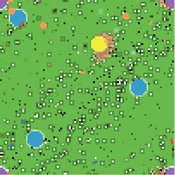
Kit Martin | Published Thursday, January 15, 2015 | Last modified Thursday, August 27, 2015Simulates impacts of ants killing colony mates when in conflict with another nest. The murder rate is adjustable, and the environmental change is variable. The colonies employ social learning so knowledge diffusion proceeds if interactions occur.
Model supporting the serious game RÁC
Patrick Taillandier Alexis Drogoul Léo Biré | Published Thursday, January 25, 2024This model is supporting the serious game RÁC (“waste” in Vietnamese), dedicated to foster discussion about solid waste management in a Vietnamese commune in the Bắc Hưng Hải irrigation system.
The model is replicating waste circulation and environmental impact in four fictive villages. During the game, the players take actions and see how their decisions have an impact on the model.
This model was implemented using the GAMA platform, using gaml language.
Social Construction of Reality Agent-Based Model
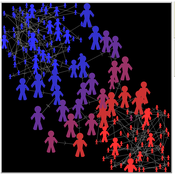
Manuel Castañón-Puga E. Dante Suarez Loren Demerath | Published Saturday, June 29, 2024This model illustrates the processes underlying the social construction of reality through an agent-based genetic algorithm. By simulating the interactions of agents within a structured environment, we have demonstrated how shared information and popularity contribute to the formation of emergent social structures with diverse cultures. The model illustrates how agents balance environmentally valid information with socially reliable information. It also highlights how social interaction leads to the formation of stable, yet diverse, social groups.
Displaying 10 of 994 results for "Dave van Wees" clear search