Our mission is to help computational modelers develop, document, and share their computational models in accordance with community standards and good open science and software engineering practices. Model authors can publish their model source code in the Computational Model Library with narrative documentation as well as metadata that supports open science and emerging norms that facilitate software citation, computational reproducibility / frictionless reuse, and interoperability. Model authors can also request private peer review of their computational models. Models that pass peer review receive a DOI once published.
All users of models published in the library must cite model authors when they use and benefit from their code.
Please check out our model publishing tutorial and feel free to contact us if you have any questions or concerns about publishing your model(s) in the Computational Model Library.
Displaying 10 of 247 results for "Marcel Hurtado" clear search
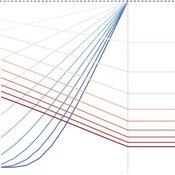
Peer reviewed Price Evolution with Expectations
J M Applegate Gesine Steudel Armin Haas Carlo Jaeger | Published Friday, September 10, 2021The Price Evolution with Expectations model provides the opportunity to explore the question of non-equilibrium market dynamics, and how and under which conditions an economic system converges to the classically defined economic equilibrium. To accomplish this, we bring together two points of view of the economy; the classical perspective of general equilibrium theory and an evolutionary perspective, in which the current development of the economic system determines the possibilities for further evolution.
The Price Evolution with Expectations model consists of a representative firm producing no profit but producing a single good, which we call sugar, and a representative household which provides labour to the firm and purchases sugar.The model explores the evolutionary dynamics whereby the firm does not initially know the household demand but eventually this demand and thus the correct price for sugar given the household’s optimal labour.
The model can be run in one of two ways; the first does not include money and the second uses money such that the firm and/or the household have an endowment that can be spent or saved. In either case, the household has preferences for leisure and consumption and a demand function relating sugar and price, and the firm has a production function and learns the household demand over a set number of time steps using either an endogenous or exogenous learning algorithm. The resulting equilibria, or fixed points of the system, may or may not match the classical economic equilibrium.
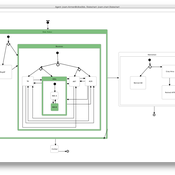
Life Cycle Cost of Military Manpower Model
Jonathan Ozik Todd Combs | Published Monday, January 05, 2015We demonstrate how Repast Simphony statecharts can efficiently encapsulate the deep classification hierarchy of the U.S. Air Force for manpower life cycle costing.
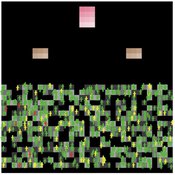
CA-MRSA Demonstration Model
Jonathan Ozik Charles Macal Kenneth Letendre Irene Lee | Published Tuesday, January 06, 2015We demonstrate how a simple model of community associated Methicillin-resistant Staphylococcus aureus (CA-MRSA) can be easily constructed by leveraging the statecharts and ReLogo capabilities in Repast Simphony.
Evolution of cooperative strategies from first principles
Marco Janssen | Published Monday, January 04, 2010 | Last modified Saturday, April 27, 2013The purpose of this model is to study the evolution of cooperation when agents are endowed with a limited set of receptors, a set of elementary actions and a neural network agents use to make decision
Evolution of cooperation with strangers
Marco Janssen | Published Friday, October 15, 2010 | Last modified Wednesday, November 13, 2013The model is used to study the conditions under which agents will cooperate in one-shot two-player Prisoner’s Dilemma games if they are able to withdraw from playing the game and can learn to recogniz
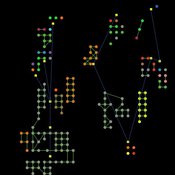
Lansing-Kremer model of the Balinese irrigation system
Marco Janssen | Published Monday, June 16, 2008 | Last modified Tuesday, December 16, 2014This is a NetLogo replication of the hill-climbing version of the Lansing-Kremer model of Balinese irrigation.

Evolution of altruistic punishment
Marco Janssen | Published Wednesday, September 03, 2008 | Last modified Saturday, March 09, 2019In the model agents make decisions to contribute of not to the public good of a group, and cooperators may punish, at a cost, defectors. The model is based on group selection, and is used to understan
Population aggregation in ancient arid environments
Marco Janssen | Published Tuesday, May 04, 2010 | Last modified Saturday, April 27, 2013The purpose of this model is to help understand how prehistoric societies adapted to the prehistoric American southwest landscape. In the American southwest there is a high degree of environmental var
Model to simulation the landscape of possible shedding games
Marco Janssen | Published Sunday, May 16, 2010 | Last modified Saturday, April 27, 2013This model simulates 2048 versions of shedding games and evaluates the consequences on the average length and the difficulty of the game agents experience. The purpose of the model is to understand th
Evolution of shedding games
Marco Janssen | Published Sunday, May 16, 2010 | Last modified Saturday, April 27, 2013This simulates the evolution of rules of shedding games based on cultural group selection. A number of groups play shedding games and evaluate the consequences on the average length and the difficulty
Displaying 10 of 247 results for "Marcel Hurtado" clear search