Our mission is to help computational modelers develop, document, and share their computational models in accordance with community standards and good open science and software engineering practices. Model authors can publish their model source code in the Computational Model Library with narrative documentation as well as metadata that supports open science and emerging norms that facilitate software citation, computational reproducibility / frictionless reuse, and interoperability. Model authors can also request private peer review of their computational models. Models that pass peer review receive a DOI once published.
All users of models published in the library must cite model authors when they use and benefit from their code.
Please check out our model publishing tutorial and feel free to contact us if you have any questions or concerns about publishing your model(s) in the Computational Model Library.
Displaying 10 of 70 results for "Ram Babu Roy" clear search
Peer reviewed The Effect of Spatial Clustering on Stone Raw Material Procurement
Marco Janssen Simen Oestmo Curtis W Marean | Published Friday, April 21, 2017This model allows for the investigation of the effect spatial clustering of raw material sources has on the outcome of the neutral model of stone raw material procurement by Brantingham (2003).
Exploring Pesticide use and Inter-row management in European Vineyards and their potential Impacts (EPIEVI)
Nina Schwarz Yang Chen | Published Tuesday, January 24, 2023The purpose of this study is to explore the potential impacts of pesticide use and inter-row management of European winegrowers in response to policy designs and climate change. Pesticides considered in this study include insecticides, pheromone dispensers (as an alternative to insecticides), fungicides (both the synthetic type and copper-sulphur based). Inter-row management concerns the arrangement of vegetation in the inter-rows and the type of vegetation.
Three-Goods Trader 2019
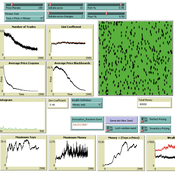
Timothy Gooding | Published Sunday, February 24, 2019This is the Toy Trader but with two additional goods being traded.
A Toy Model for the Abilene Paradox
Victor Sahin | Published Monday, June 17, 2019 | Last modified Sunday, July 14, 2019This version adds a Maslowian entropy to each agent decision based on Kendrick et. al. Rudimentary implementation assumes agents with lower scores are more likely to make decisions autonomously rather than sociotropically.
Local soy value chains in northern Ghana
Tim Verwaart | Published Thursday, August 29, 2019The purpose of the simulation is to evaluate alternative interventions by a value chain development program, aiming to improve rural livelihood and food and nutrition security. In northern Ghana, where distrust between the partners can be a problem in the functioning of value chains, the program supports the incorporation of smallholder farmers in soy clusters or agriculture APEX organization (farmers’ co-operatives) with a fair business environment. The goal is to to include the smallholder farmers in a strong value chain and reduce distrust.
Automatic multi game chess
Julia Kasmire | Published Monday, July 22, 2019This model converts cleaned up versions of .pgn files (records of real chess games) and conversts them into files that record all of the events and “possible” events within a game of chess. This is intended to be a way to create sets of data that capture event sequences within the relatively complex but finite context of chess games as a proxy or “toy” data set. Although not a perfect correlation, these toy data sets are a first step in analysing complex and dynamic systems of events and possible events that happen in the real world.
Peer reviewed Lithic Raw Material Procurement and Provisioning
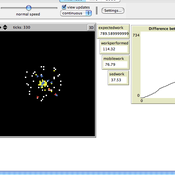
Jonathan Paige | Published Friday, March 06, 2015 | Last modified Thursday, March 12, 2015This model simulates the lithic raw material use and provisioning behavior of a group that inhabits a permanent base camp, and uses stone tools.
User Guide and Templates for RAT-RS (a reporting standard for improving the documentation of data use in agent-based modelling)
Melania Borit Edmund Chattoe-Brown Peer-Olaf Siebers Sebastian Achter | Published Saturday, March 12, 2022The Rigor and Transparency Reporting Standard (RAT-RS) is a tool to improve the documentation of data use in Agent-Based Modelling. Following the development of reporting standards for models themselves, attention to empirical models has now reached a stage where these standards need to take equally effective account of data use (which until now has tended to be an afterthought to model description). It is particularly important that a standard should allow the reporting of the different uses to which data may be put (specification, calibration and validation), but also that it should be compatible with the integration of different kinds of data (for example statistical, qualitative, ethnographic and experimental) sometimes known as mixed methods research.
For the full details on the RAT-RS, please refer to the related publication “RAT-RS: A Reporting Standard for Improving the Documentation of Data Use in Agent-Based Modelling” (http://dx.doi.org/10.1080/13645579.2022.2049511).
Here we provide supplementary material for this article, consisting of a RAT-RS user guide and RAT-RS templates.
One Signal, Many Feeds: An Empirical-Response Agent-Based Model of Coordination Failure in Algorithmic Creator Discovery
Haocheng Wang | Published Thursday, August 06, 2026An empirical-response agent-based model of how many personalized feeds execute a shared low-exposure creator-discovery objective. Built from the KuaiRec dataset: the big interaction matrix initializes a transparent rank-8 matrix-factorization platform learner and the activity schedule, while the near-complete small matrix returns observed viewing responses only after a user-video pair is exposed. Four exploration policies (synchronous low-exposure targeting, uniform exploration, per-user random tie-breaking, capacity-balanced coordination) are compared over 28 rounds at a nominal 10% exploration budget, across 30 paired seeds (core) and 10 paired seeds (bias-only probe), with slot-level redundancy, cross-user collision, and coverage diagnostics.
This release accompanies an anonymised manuscript under review at the Journal of Artificial Societies and Social Simulation.
The model represents 1,411 users, 3,327 videos, 2,031 authors, and an adaptive platform over 28 discrete rounds derived from the KuaiRec big-matrix activity calendar. Exploration policies differ only in how a fixed 10% slot budget is allocated; all policies share the opportunity schedule, response oracle, initial checkpoints, and online update rule.
Archive contents: analysis pipeline scripts (01-16), frozen machine-readable protocols with input hashes, initial model checkpoints, aggregate result tables, the complete ODD protocol record, and publication figures. Raw KuaiRec files are not redistributed; obtain them from the official dataset repository and verify against the input hashes in data_contract/. Row-level oracle tables are excluded by design.
…
Peer reviewed Two-stage migration decisions in a conceptual regions
Woi Sok Oh Alvaro Carmona Cabrero Rafael Muñoz-Carpena Rachata Muneepeerakul | Published Friday, April 01, 2022This proof-of-concept model explores the effects of how social and natural factors are incorporated (factor configuration) in environmentally induced migration. It is built in a conceptual environment where five regions are located in a row.
Displaying 10 of 70 results for "Ram Babu Roy" clear search