Our mission is to help computational modelers develop, document, and share their computational models in accordance with community standards and good open science and software engineering practices. Model authors can publish their model source code in the Computational Model Library with narrative documentation as well as metadata that supports open science and emerging norms that facilitate software citation, computational reproducibility / frictionless reuse, and interoperability. Model authors can also request private peer review of their computational models. Models that pass peer review receive a DOI once published.
All users of models published in the library must cite model authors when they use and benefit from their code.
Please check out our model publishing tutorial and feel free to contact us if you have any questions or concerns about publishing your model(s) in the Computational Model Library.
Displaying 10 of 1012 results for "Chantal van Esch" clear search
Human-in-the-loop Experiment of the Strategic Coalition Formation using the glove game
Andrew Collins | Published Monday, November 23, 2020 | Last modified Wednesday, June 22, 2022The purpose of the model is to collect information on human decision-making in the context of coalition formation games. The model uses a human-in-the-loop approach, and a single human is involved in each trial. All other agents are controlled by the ABMSCORE algorithm (Vernon-Bido and Collins 2020), which is an extension of the algorithm created by Collins and Frydenlund (2018). The glove game, a standard cooperative game, is used as the model scenario.
The intent of the game is to collection information on the human players behavior and how that compares to the computerized agents behavior. The final coalition structure of the game is compared to an ideal output (the core of the games).
Network Behaviour Diffusion
Jennifer Badham | Published Saturday, October 02, 2021This model implements two types of network diffusion from an initial group of activated nodes. In complex contagion, a node is activated if the proportion of neighbour nodes that are already activated exceeds a given threshold. This is intended to represented the spread of health behaviours. In simple contagion, an activated node has a given probability of activating its inactive neighbours and re-tests each time step until all of the neighbours are activated. This is intended to represent information spread.
A range of networks are included with the model from secondary school friendship networks. The proportion of nodes initially activated and the method of selecting those nodes are controlled by the user.
Emergency Warning Dissemination in a Multiplex Social Network
Charles Koll | Published Tuesday, January 31, 2023This is an interdisciplinary agent-based model with Monte Carlo simulations to assess the relative effects of broadcast and contagion processes in a multiplex social network. This multiplex approach models multiple channels of informal communication - phone, word-of-mouth, and social media - that vary in their attribute values. Each agent is an individual in a threatened community who, once warned, has a probability of warning others in their social network using one of these channels. The probability of an individual warning others is based on their warning source and the time remaining until disaster impact, among other variables. Default parameter values were chosen from empirical studies of disaster warnings along with the spatial aspects of Coos Bay, OR, USA and Seaside, OR, USA communities.

Peer reviewed Yards
srailsback Emily Minor Soraida Garcia Philip Johnson | Published Thursday, November 02, 2023This is a model of plant communities in urban and suburban residential neighborhoods. These plant communities are of interest because they provide many benefits to human residents and also provide habitat for wildlife such as birds and pollinators. The model was designed to explore the social factors that create spatial patterns in biodiversity in yards and gardens. In particular, the model was originally developed to determine whether mimicry behaviors–-or neighbors copying each other’s yard design–-could produce observed spatial patterns in vegetation. Plant nurseries and socio-economic constraints were also added to the model as other potential sources of spatial patterns in plant communities.
The idea for the model was inspired by empirical patterns of spatial autocorrelation that have been observed in yard vegetation in Chicago, Illinois (USA), and other cities, where yards that are closer together are more similar than yards that are farther apart. The idea is further supported by literature that shows that people want their yards to fit into their neighborhood. Currently, the yard attribute of interest is the number of plant species, or species richness. Residents compare the richness of their yards to the richness of their neighbors’ yards. If a resident’s yard is too different from their neighbors, the resident will be unhappy and change their yard to make it more similar.
The model outputs information about the diversity and identity of plant species in each yard. This can be analyzed to look for spatial autocorrelation patterns in yard diversity and to explore relationships between mimicry behaviors, yard diversity, and larger scale diversity.
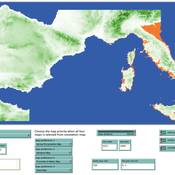
Geographic Expansion Model (GEM)
Sean Bergin | Published Friday, February 28, 2020The purpose of this model is to explore the importance of geographic factors to the settlement choices of early Neolithic agriculturalists. In the model, each agriculturalist spreads to one of the best locations within a modeler specified radius. The best location is determined by choosing either one factor such as elevation or slope; or by ranking geographic factors in order of importance.
Dental Routine Check-Up
Peyman Shariatpanahi Afshin Jafari | Published Thursday, March 10, 2016 | Last modified Monday, April 08, 2019We develop an agent-based model for collective behavior of routine medical check-ups, and specifically dental visits, in a social network.

A consumer-demand simulation for Smart Metering tariffs (Innovation Diffusion)
Martin Rixin | Published Thursday, August 18, 2011 | Last modified Saturday, April 27, 2013An Agent-based model simulates consumer demand for Smart Metering tariffs. It utilizes the Bass Diffusion Model and Rogers´s adopter categories. Integration of empirical census microdata enables a validated socio-economic background for each consumer.
The Effect of Merger and Acquisitions on the IS Function: An Agent Based Simulation Model
Andrea Genovese | Published Tuesday, June 23, 2009 | Last modified Saturday, April 27, 2013Merger and acquisition (M&A) activity has many strategic and operational objectives. One operational objective is to develop common and efficient information systems that maybe the source of creating
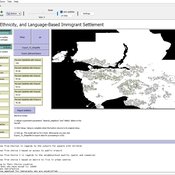
Geospatial Agent-Based Model of Immigrant Settlement Dynamics in Metro Vancouver
Liliana Perez Navid Mahdizadeh Gharakhanlou Maryam Yousefi | Published Wednesday, December 03, 2025This agent-based model simulates how new immigrant households choose where to live in Metro Vancouver under the origins diversity scenario. The model begins with 16,000 household agents, reflecting an expected annual population increase of about 42,500 people based on an average household size of 2.56. Each agent is assigned four characteristics: one of ten origin categories, income level (adjusted using NOC data and recent immigrant earnings), likelihood of having children, and preferred mode of commuting. The ten origin groups are drawn from Census patterns, including six subgroups within the broader Asian category (China, India, the Philippines, Iran, South Korea, and Other Asian countries) and two categories for immigrants from the Americas. This refined classification better captures the diversity of newcomers arriving in the region.
Resisting hostility
Sylvie Huet | Published Thursday, December 20, 2018We propose an agent-based model leading to a decrease or an increase of hostility between agents after a major cultural threat such as a terrorist attack. The model is inspired from the Terror Management Theory and the Social Judgement Theory. An agent has a cultural identity defined through its acceptance segments about each of three different cultural worldviews (i.e., Atheist, Muslim, Christian) of the considered society. An agent’s acceptance segment is composed from its acceptable positions toward a cultural worldview, including its most acceptable position. An agent forms an attitude about another agent depending on the similarity between their cultural identities. When a terrorist attack is perpetrated in the name of an extreme cultural identity, the negatively perceived agents from this extreme cultural identity point of view tend to decrease the width of their acceptance segments in order to differentiate themselves more from the threatening cultural identity
Displaying 10 of 1012 results for "Chantal van Esch" clear search