Our mission is to help computational modelers develop, document, and share their computational models in accordance with community standards and good open science and software engineering practices. Model authors can publish their model source code in the Computational Model Library with narrative documentation as well as metadata that supports open science and emerging norms that facilitate software citation, computational reproducibility / frictionless reuse, and interoperability. Model authors can also request private peer review of their computational models. Models that pass peer review receive a DOI once published.
All users of models published in the library must cite model authors when they use and benefit from their code.
Please check out our model publishing tutorial and feel free to contact us if you have any questions or concerns about publishing your model(s) in the Computational Model Library.
Displaying 10 of 527 results for "Jingjing Cai" clear search
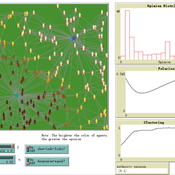
How Does Culture Affect Vaccination Opinion Polarisation?
Teng Li | Published Monday, March 10, 2025This model is to explore how individuals’ cultural backgrounds may play a role in their Covid vaccination decision-making. Two cultural dimensions of collectivism/individualism and power distance are considered. Through the experimental scenarios, we find that Covid-vaccination opinions in collectivist societies can also be considerably polarised, if the power distance is less and authorities less centralised. This result complements the popular idea that cultural collectivism is usually associated with a high degree of social consensus. Hopefully, this study will help explain countries’ difference in the response of Covid vaccination programs.
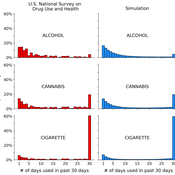
A simple computational algorithm for simulating population substance use
Jacob Borodovsky | Published Thursday, March 27, 2025This code simulates individual-level, longitudinal substance use patterns that can be used to understand how cross-sectional U-shaped distributions of population substance use emerge. Each independent computational object transitions between two states: using a substance (State 1), or not using a substance (State 2). The simulation has two core components. Component 1: each object is assigned a unique risk factor transition probability and unique protective factor transition probability. Component 2: each object’s current decision to use or not use the substance is influenced by the object’s history of decisions (i.e., “path dependence”).
An Agent-based model of the economy with consumer credit
Paola D'Orazio Gianfranco Giulioni | Published Friday, April 15, 2016 | Last modified Thursday, March 07, 2019The model was built to study the links between consumer credit, wealth distribution and aggregate demand in a complex macroeconomics system.

LimnoSES - social-ecological lake management undergoing regime shifts
Romina Martin | Published Thursday, November 24, 2016 | Last modified Friday, January 18, 2019LimnoSES is a coupled system dynamics, agent-based model to simulate social-ecological feedbacks in shallow lake use and management.
Hohokam Water Management Simulation (HWM)
John Murphy | Published Wednesday, August 31, 2011 | Last modified Saturday, April 27, 2013Simulation of irrigation system management using archaeological data from southern Arizona
Alpine land-use allocation model - ALUAM-AB
Simon Briner | Published Tuesday, January 31, 2012 | Last modified Saturday, April 27, 2013A model for simulating farmers and foresters response on changing climate and changing socio-economic parameters. Modeled are changes in land-use as well as in ecosystem services provision.

Absorption of particulate matter by leafs
Georg Jäger Chiara Letter | Published Monday, November 12, 2018 | Last modified Monday, November 12, 2018This model aims to understand the interaction between particulate matter and leaves of trees. The particles collide with the leaf and can either be absorbed with a certain probability, otherwise they bounce off it. The absorptions are detected in a counter.
The movement of the particles depends mainly on the strength and direction of the wind and the air temperature. They also show a certain random movement, but the proportion is negligible.
In a collision with the leaf, the particles are absorbed with a certain probability (absorption-probability), otherwise repelled.
A simplified Arthur & Polak logic circuit model of combinatory technology build-out via incremental development. Only some inventions trigger radical effects, suggesting they depend on whole interdependent systems rather than specific innovations.
The Agent-Based Model of the Closed Market( similar to Stock Market) with One Commodity and with careful and risky mechanisms
Mark Voronovitsky | Published Sunday, March 15, 2015 | Last modified Sunday, March 22, 2015The model of market of one commodity , in which there are in each moment of time the same quantity and the same quantity of money was formulated and researched in this text. We also study this system as a game of automata.
Informal risk-sharing cooperatives : ORP and Learning
Juliette Rouchier Victorien Barbet Renaud Bourlès | Published Monday, February 13, 2017 | Last modified Tuesday, May 16, 2023The model studies the dynamics of risk-sharing cooperatives among heterogeneous farmers. Based on their knowledge on their risk exposure and the performance of the cooperative farmers choose whether or not to remain in the risk-sharing agreement.
Displaying 10 of 527 results for "Jingjing Cai" clear search