Our mission is to help computational modelers develop, document, and share their computational models in accordance with community standards and good open science and software engineering practices. Model authors can publish their model source code in the Computational Model Library with narrative documentation as well as metadata that supports open science and emerging norms that facilitate software citation, computational reproducibility / frictionless reuse, and interoperability. Model authors can also request private peer review of their computational models. Models that pass peer review receive a DOI once published.
All users of models published in the library must cite model authors when they use and benefit from their code.
Please check out our model publishing tutorial and feel free to contact us if you have any questions or concerns about publishing your model(s) in the Computational Model Library.
Displaying 10 of 208 results for "Friederike Lenel" clear search
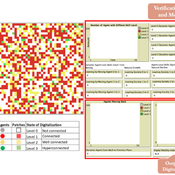
Digital Mobility Model (DMM)
Na (Richard) Jiang Fiammetta Brandajs | Published Thursday, February 01, 2024 | Last modified Friday, February 02, 2024The purpose of the Digital Mobility Model (DMM) is to explore how a society’s adoption of digital technologies can impact people’s mobilities and immobilities within an urban environment. Thus, the model contains dynamic agents with different levels of digital technology skills, which can affect their ability to access urban services using digital systems (e.g., healthcare or municipal public administration with online appointment systems). In addition, the dynamic agents move within the model and interact with static agents (i.e., places) that represent locations with different levels of digitalization, such as restaurants with online reservation systems that can be considered as a place with a high level of digitalization. This indicates that places with a higher level of digitalization are more digitally accessible and easier to reach by individuals with higher levels of digital skills. The model simulates the interaction between dynamic agents and static agents (i.e., places), which captures how the gap between an individual’s digital skills and a place’s digitalization level can lead to the mobility or immobility of people to access different locations and services.
Nudging agents in social networks for collective action
Marco Janssen | Published Sunday, August 14, 2011 | Last modified Sunday, March 17, 2019Agents are linked in a social-network and make decisions on which of 2 types of behavior to adopt. We explore consequences of different information feedback and providing targeted feedback to individuals.
The effect of error on cultural transmission
Claudine Gravel-Miguel | Published Thursday, November 01, 2012 | Last modified Saturday, April 27, 2013This is the replication of the experiment performed by Eerkens and Lipo (2005) to look at the effect of copying errors when specific traits are transferred from an individual to another.
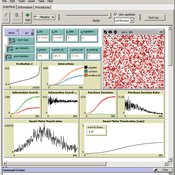
A consumer-demand simulation for Smart Metering tariffs (Innovation Diffusion)
Martin Rixin | Published Thursday, August 18, 2011 | Last modified Saturday, April 27, 2013An Agent-based model simulates consumer demand for Smart Metering tariffs. It utilizes the Bass Diffusion Model and Rogers´s adopter categories. Integration of empirical census microdata enables a validated socio-economic background for each consumer.
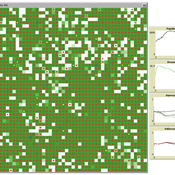
Mobility, Resource Harvesting and Robustness of Social-Ecological Systems
Irene Perez Ibarra | Published Monday, September 24, 2012 | Last modified Saturday, April 27, 2013The model is a stylized representation of a social-ecological system of agents moving and harvesting a renewable resource. The purpose is to analyze how mobility affects sustainability. Experiments changing agents’ mobility, landscape and information governments have can be run.
Peer reviewed NetLogo model of USA mass shootings
Smarzhevskiy Ivan | Published Tuesday, September 24, 2019 | Last modified Tuesday, April 14, 2020Is the mass shooter a maniac or a relatively normal person in a state of great stress? According to the FBI report (Silver, J., Simons, A., & Craun, S. (2018). A Study of the Pre-Attack Behaviors of Active Shooters in the United States Between 2000 – 2013. Federal Bureau of Investigation, U.S. Department of Justice,Washington, D.C. 20535.), only 25% of the active shooters were known to have been diagnosed by a mental health professional with a mental illness of any kind prior to the offense.
The main objects of the model are the humans and the guns. The main factors influencing behavior are the population size, the number of people with mental disabilities (“psycho” in the model terminology) per 100,000 population, the total number of weapons (“guns”) in the population, the availability of guns for humans, the intensity of stressors affecting humans and the threshold level of stress, upon reaching which a person commits an act of mass shooting.
The key difference (in the model) between a normal person and a psycho is that a psycho accumulates stressors and, upon reaching a threshold level, commits an act of mass shooting. A normal person is exposed to stressors, but reaching the threshold level for killing occurs only when the simultaneous effect of stressors on him exceeds this level.
The population dynamics are determined by the following factors: average (normally distributed) life expectancy (“life_span” attribute of humans) and population growth with the percentage of newborns set by the value of the TickReprRatio% slider of the current population volume from 16 to 45 years old.Thus, one step of model time corresponds to a year.
WatASit
Bastien RICHARD Bastien Richard Isabelle Braud Bruno Bonté Olivier Barreteau | Published Friday, December 20, 2019 | Last modified Wednesday, October 28, 2020WatASit is an agent-based model implemented in the CORMAS plateform. The model is developped to simulate irrigation situations at the operational level during a collective irrigation campaign.
Peer reviewed CapOvCWD
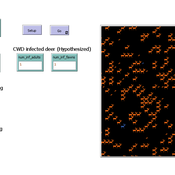
Aniruddha Belsare | Published Tuesday, September 09, 2025 | Last modified Tuesday, November 11, 2025CapOvCWD is an agent-based model that simulates a captive cervid herd composed of adults and fawns. The model deer population is initialized using data on herd size and composition from captive facility records. Individual deer domiciliary history and annual CWD testing records inform the herd size and sample size (for CWD testing), respectively. The model can be used to iteratively estimate the facility level annual CWD detection probability. Detection probability estimates can be further refined by incorporating multiyear CWD testing data. This approach can be particularly useful for interpreting negative test results from a subset of the captive herd. Facility level detection probability estimates provide a comprehensive and standardized risk metric that reflects the likelihood of undetected CWD in the facility.
How to Manage Individual Forgetting
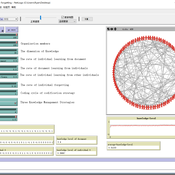
wiseyanjie | Published Wednesday, July 17, 2019we extend the basic simulation model of March by incorporating forgetting and three knowledge management strategies—personalization, codification, and mixed—to explore the impacts of different knowledge management strategies and forgetting on organizational knowledge level.
Model to assess factors that influence local communities compliance with protected areas policies
Gustavo Andrade | Published Monday, November 21, 2011 | Last modified Saturday, April 27, 2013We built a model using R,polr package, to assess 55 published case studies from developing countries to determine what factors influence the level of compliance of local communities with protected area regulations.
Displaying 10 of 208 results for "Friederike Lenel" clear search