Our mission is to help computational modelers develop, document, and share their computational models in accordance with community standards and good open science and software engineering practices. Model authors can publish their model source code in the Computational Model Library with narrative documentation as well as metadata that supports open science and emerging norms that facilitate software citation, computational reproducibility / frictionless reuse, and interoperability. Model authors can also request private peer review of their computational models. Models that pass peer review receive a DOI once published.
All users of models published in the library must cite model authors when they use and benefit from their code.
Please check out our model publishing tutorial and feel free to contact us if you have any questions or concerns about publishing your model(s) in the Computational Model Library.
Displaying 10 of 272 results for "Philipp S. Sommer" clear search

Peer reviewed Ants Digging Networks
Elske van der Vaart | Published Friday, September 14, 2018This is a NetLogo version of Buhl et al.’s (2005) model of self-organised digging activity in ant colonies. It was built for a master’s course on self-organisation and its intended use is still educational. The ants’ behavior can easily be changed by toggling switches on the interface, or, for more advanced students, there is R code included allowing the model to be run and analysed through RNetLogo.
CPNorm
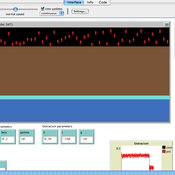
Ruth Meyer | Published Sunday, June 04, 2017 | Last modified Tuesday, June 13, 2017CPNorm is a model of a community of harvesters using a common pool resource where adhering to the optimal extraction level has become a social norm. The model can be used to explore the robustness of norm-driven cooperation in the commons.
Cascades across networks are sufficient for the formation of echo chambers: An agent-based model
Jan-Philipp Fränken | Published Monday, January 11, 2021An agent-based model of echo chamber formation employing a Bayesian Source Credibility cognitive architecture limiting interactions to a single cascade.
An agent-based model to study the effects of urban sprawl on bird distribution
Yun Ouyang | Published Tuesday, December 16, 2008 | Last modified Saturday, April 27, 2013This model was programmed for a class project, which studied the effects of urban sprawl on bird distribution. For the urban sprawl part of the model, we started from the model in (udhira, H. S., 200
Human Resource Management Parameter Experimentation Tool
Carmen Iasiello | Published Thursday, May 07, 2020 | Last modified Thursday, February 25, 2021The agent based model presented here is an explicit instantiation of the Two-Factor Theory (Herzberg et al., 1959) of worker satisfaction and dissatisfaction. By utilizing agent-based modeling, it allows users to test the empirically found variations on the Two-Factor Theory to test its application to specific industries or organizations.
Iasiello, C., Crooks, A.T. and Wittman, S. (2020), The Human Resource Management Parameter Experimentation Tool, 2020 International Conference on Social Computing, Behavioral-Cultural Modeling & Prediction and Behavior Representation in Modeling and Simulation, Washington DC.
LaMEStModel
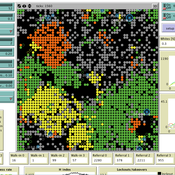
Ruth Meyer | Published Friday, October 12, 2018The Labour Markets and Ethnic Segmentation (LaMESt) Model is a model of a simplified labour market, where only jobs of the lowest skill level are considered. Immigrants of two different ethnicities (“Latino”, “Asian”) compete with a majority (“White”) and minority (“Black”) native population for these jobs. The model’s purpose is to investigate the effect of ethnically homogeneous social networks on the emergence of ethnic segmentation in such a labour market. It is inspired by Waldinger & Lichter’s study of immigration and the social organisation of labour in 1990’s Los Angeles.
Social Identity Model of Protest Emergence (SIMPE)
Cristina Chueca Del Cerro | Published Friday, March 17, 2023The Social Identity Model of Protest Emergence (SIMPE), an agent-based model of national identity and protest mobilisations.
I developed this model for my PhD project, “Polarisation and Protest Mobilisation Around Secessionist Movements: an Agent-Based Model of Online and Offline Social Networks”, at the University of Glasgow (2019-2023).
The purpose of this model is to simulate protest emergence in a given country where there is an independence movement, fostering the self-categorisation process of national identification. In order to contextualised SIMPE, I have used Catalonia, where an ongoing secessionist movement since 2011 has been present, national identity has shown signs of polarisation, and where numerous mobilisations have taken place over the last decade. Data from the Catalan Centre of Opinion Studies (CEO) has been used to inform some of the model parameters.
…
Replication of ECEC model: Environmental Feedback and the Evolution of Cooperation
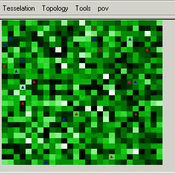
Pierre Bommel | Published Tuesday, April 05, 2011 | Last modified Saturday, April 27, 2013The model, presented here, is a re-implementation of the Pepper and Smuts’ model : - Pepper, J.W. and B.B. Smuts. 2000. “The evolution of cooperation in an ecological context: an agent-based model”. Pp. 45-76 in T.A. Kohler and G.J. Gumerman, eds. Dynamics of human and primate societies: agent-based modeling of social and spatial processes. Oxford University Press, Oxford. - Pepper, J.W. and B.B. Smuts. 2002. “Assortment through Environmental Feedback”. American Naturalist, 160: 205-213 […]
A consumer-demand simulation for Smart Metering tariffs (Innovation Diffusion)
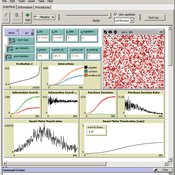
Martin Rixin | Published Thursday, August 18, 2011 | Last modified Saturday, April 27, 2013An Agent-based model simulates consumer demand for Smart Metering tariffs. It utilizes the Bass Diffusion Model and Rogers´s adopter categories. Integration of empirical census microdata enables a validated socio-economic background for each consumer.
CITMOD A Tax-Benefit Modeling System for the average citizen
Philip Truscott | Published Monday, August 15, 2011 | Last modified Saturday, April 27, 2013Must tax-benefit policy making be limited to the ‘experts’?
Displaying 10 of 272 results for "Philipp S. Sommer" clear search