Our mission is to help computational modelers develop, document, and share their computational models in accordance with community standards and good open science and software engineering practices. Model authors can publish their model source code in the Computational Model Library with narrative documentation as well as metadata that supports open science and emerging norms that facilitate software citation, computational reproducibility / frictionless reuse, and interoperability. Model authors can also request private peer review of their computational models. Models that pass peer review receive a DOI once published.
All users of models published in the library must cite model authors when they use and benefit from their code.
Please check out our model publishing tutorial and feel free to contact us if you have any questions or concerns about publishing your model(s) in the Computational Model Library.
Displaying 10 of 1227 results for "Ian M Hamilton" clear search
ManPest
François Rebaudo | Published Tuesday, February 25, 2014 | Last modified Wednesday, August 27, 2014The purpose of the model is to explore the impacts of global change on the ability of a community of farmers to adapt their practices to an agricultural pest.
Replica of Turchin's (2003) Metaethnic Frontier model
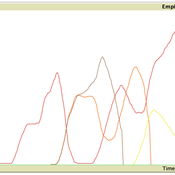
Paul Smaldino | Published Sunday, February 15, 2026In his 2003 book, Historical Dynamics (ch. 4), Turchin describes and briefly analyzes a spatial ABM of his metaethnic frontier theory, which is essentially a formalization of a theory by Ibn Khaldun in the 14th century. In the model, polities compete with neighboring polities and can absorb them into an empire. Groups possess “asabiya”, a measure of social solidarity and a sense of shared purpose. Regions that share borders with other groups will have increased asabiya do to salient us vs. them competition. High asabiya enhances the ability to grow, work together, and hence wage war on neighboring groups and assimilate them into an empire. The larger the frontier, the higher the empire’s asabiya.
As an empire expands, (1) increased access to resources drives further growth; (2) internal conflict decreases asabiya among those who live far from the frontier; and (3) expanded size of the frontier decreases ability to wage war along all frontiers. When an empire’s asabiya decreases too much, it collapses. Another group with more compelling asabiya eventually helps establish a new empire.
Peer reviewed Industrial Symbiosis Network implementation ABM
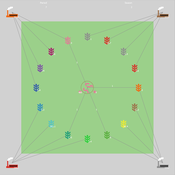
Igor Nikolic Kasper Pieter Hendrik Lange Gijsbert Korevaar Paulien Herder | Published Tuesday, December 01, 2020 | Last modified Wednesday, June 16, 2021The purpose of the model is to explore the influence of actor behaviour, combined with environment and business model design, on the survival rates of Industrial Symbiosis Networks (ISN), and the cash flows of the agents. We define an ISN to be robust, when it is able to run for 10 years, without falling apart due to leaving agents.
The model simulates the implementation of local waste exchange collaborations for compost production, through the ISN implementation stages of awareness, planning, negotiation, implementation, and evaluation.
One central firm plays the role of waste processor in a local composting initiative. This firm negotiates with other firms to become a supplier of their organic residual streams. The waste suppliers in the model can decide to join the initiative, or to have the waste brought to the external waste incinerator. The focal point of the model are the company-level interactions during the implementation or ending of synergies.
…
Hollywood Underrepresentation Simulated Causes
Carmen Iasiello | Published Sunday, November 26, 2023Presented here is a socioeconomic agent-based model (ABM) to examine the Hollywood labor system as a network within a simulated movie labor market based on preferential attachment and compare the findings with 50 co-production ego networks during the 2015 movie year. Using the ABM, I test the role slight individual preference for racial and ethnic similarity within one’s own network at the microlevel and find that it is insufficient to explain the phenomena of racial and ethnic underrepresentation at the macrolevel. The ABM also includes the ability to test alternative explanations, such as overt opportunity loss as a possible explanation.
Irrigation game
Marco Janssen | Published Monday, July 23, 2012 | Last modified Saturday, April 27, 2013Irrigation game calibrated on experimental data
AAAPS: AI-Augmented Academic Performance Simulation
Tuul Triyason | Published Wednesday, July 22, 2026Agent-based model simulating 60 undergraduate CS students over 8 semesters to investigate how differential AI tool access affects academic inequality, performance distributions, and dependency formation. Implements a three-phase AI dependency mechanism (effort reduction, metacognitive miscalibration, capability erosion) under five policy scenarios with a 4,050-run parameter sensitivity sweep.

Peer reviewed Circular Business Model experimentation: local biodigestion network
Igor Nikolic Kasper Pieter Hendrik Lange Gijsbert Korevaar Paulien Herder | Published Thursday, December 17, 2020 | Last modified Tuesday, June 29, 2021The purpose of the model is to explore the influence of the design of circular business models (CBMs) on CBM viability. The model represents an Industrial Symbiosis Network (ISN) in which a processor uses the organic waste from suppliers to produce biogas and nutrient rich digestate for local reuse. CBM viability is expressed as value captured (e.g., cash flow/tonne waste/agent) and the survival of the network over time (shown in the interface).
In the model, the value captured is calculated relative to the initial state, using incineration costs as a benchmark. Moderating variables are interactions with the waste incinerator and actor behaviour factors. Actors may leave the network when the waste supply for local production is too low, or when personal economic benefits are too low. When the processor decides to leave, the network fails. Theory of planned behaviour can be used to include agent behaviour in the simulations.
External shocks, agent interactions, and endogenous feedbacks--investigating system resilience with a stylized land use model
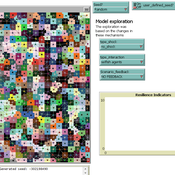
Yang Chen | Published Tuesday, March 06, 2018The purpose of the presented ABM is to explore how system resilience is affected by external disturbances and internal dynamics by using the stylized model of an agricultural land use system.
We explore land system resilience with a stylized land use model in which agents’ land use activities are affected by external shocks, agent interactions, and endogenous feedbacks. External shocks are designed as yield loss in crops, which is ubiquitous in almost every land use system where perturbations can occur due to e.g. extreme weather conditions or diseases. Agent interactions are designed as the transfer of buffer capacity from farmers who can and are willing to provide help to other farmers within their social network. For endogenous feedbacks, we consider land use as an economic activity which is regulated by markets — an increase in crop production results in lower price (a negative feedback) and an agglomeration of a land use results in lower production costs for the land use type (a positive feedback).
Classrooms; teachers, students and learning
petertymms | Published Wednesday, October 07, 2020This a phenomenon-based model plan. Classroom in school are places when students are supposed to learn and the most often do. But things can go awry, the students can play up and that can result in an unruly class and learning can suffer. This model aims to look at how much students learn according to how good the teacher is a classroom control and how good he or she is at teaching per se.
Ornstein-Uhlenbeck Pandemic package
Peter Cotton | Published Friday, April 24, 2020 | Last modified Friday, May 08, 2020Pandemic (pip install pandemic)
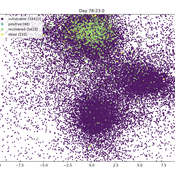
An agent model in which commuting, compliance, testing and contagion parameters drive infection in a population of thousands of millions. Agents follow Ornstein-Uhlenbeck processes in the plane and collisions drive transmission. Results are stored at SwarmPrediction.com for further analysis, and can be retrieved by anyone.
This is a very simple simulation that in a special case can be shown to be approximated by a compartmental model with time varying infection rate.
Displaying 10 of 1227 results for "Ian M Hamilton" clear search