Our mission is to help computational modelers develop, document, and share their computational models in accordance with community standards and good open science and software engineering practices. Model authors can publish their model source code in the Computational Model Library with narrative documentation as well as metadata that supports open science and emerging norms that facilitate software citation, computational reproducibility / frictionless reuse, and interoperability. Model authors can also request private peer review of their computational models. Models that pass peer review receive a DOI once published.
All users of models published in the library must cite model authors when they use and benefit from their code.
Please check out our model publishing tutorial and feel free to contact us if you have any questions or concerns about publishing your model(s) in the Computational Model Library.
Displaying 10 of 957 results for "Coen Van Wagenberg" clear search
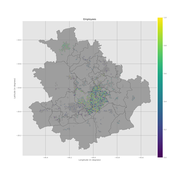
PolicySpace: agent-based modeling
Francisco Miguel Quesada Bernardo Furtado Isaque Daniel Rocha Eberhardt | Published Tuesday, March 06, 2018PolicySpace models public policies within an empirical, spatial environment using data from 46 metropolitan regions in Brazil. The model contains citizens, markets, residences, municipalities, commuting and a the tax scheme. In the associated publications (book in press and https://arxiv.org/abs/1801.00259) we validate the model and demonstrate an application of the fiscal analysis. Besides providing the basics of the platform, our results indicate the relevance of the rules of taxes transfer for cities’ quality of life.
Endogenous changes in public opinion dynamics
Francisco J. León-Medina | Published Tuesday, June 05, 2018The model formalizes a situation where agents embedded in different types of networks (random, small world and scale free networks) interact with their neighbors and express an opinion that is the result of different mechanisms: a coherence mechanism, in which agents try to stick to their previously expressed opinions; an assessment mechanism, in which agents consider available external information on the topic; and a social influence mechanism, in which agents tend to approach their neighbor’s opinions.
The role of dispersal, selection intensity, and extirpation risk in resilience to climate change: a trait-based modeling approach
Jessica Mo P. David Polly | Published Monday, February 07, 2022This NetLogo model simulates trait-based biotic responses to climate change in an environmentally heterogeneous continent in an evolving clade, the species of which are each represented by local populations that disperse and interbreed; they also are subject to selection, genetic drift, and local extirpation. We simulated mammalian herbivores, whose success depends on tooth crown height, vegetation type, precipitation and grit. This model investigates the role of dispersal, selection, extirpation, and other factors contribute to resilience under three climate change scenarios.
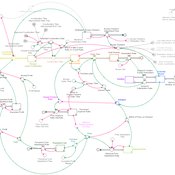
Endogenous Dynamics of Housing Market Cycles
Onur Özgün Birnur Özbaş Yaman Barlas | Published Monday, September 09, 2013 | Last modified Wednesday, January 08, 2014The purpose of this model is to analyze the dynamics of endogenously created oscillations in housing prices using a system dynamics simulation model, built from the perspective of construction companies.
Social identity approach in a data-driven Axelrod model
alejandrodinkelberg | Published Thursday, July 28, 2022Simulations based on the Axelrod model and extensions to inspect the volatility of the features over time (AXELROD MODEL & Agreement threshold & two model variations based on the Social identity approach)
The Axelrod model is used to predict the number of changes per feature in comparison to the datasets and is used to compare different model variations and their performance.
Input: Real data
…
Nudging agents in social networks for collective action
Marco Janssen | Published Sunday, August 14, 2011 | Last modified Sunday, March 17, 2019Agents are linked in a social-network and make decisions on which of 2 types of behavior to adopt. We explore consequences of different information feedback and providing targeted feedback to individuals.

Eixample-MAS Traffic Simulation
Àlex Pardo Fernandez David Sánchez Pinsach | Published Tuesday, January 22, 2013 | Last modified Saturday, April 27, 2013This MAS simulates the traffic of Barcelona Eixample. Uses a centralized AI system in order to control the traffic lights. Car agents are reactive and have no awareness of the intelligence of the system. They (try to) avoid collisions.
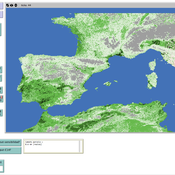
Cultural Spread
Salvador Pardo Gordó Salvador Pardo-Gordó | Published Thursday, April 02, 2015 | Last modified Thursday, April 23, 2020The purpose of the model is to simulate the cultural hitchhiking hypothesis to explore how neutral cultural traits linked with advantageous traits spread together over time
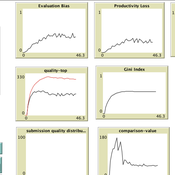
Peer Review Game
Giangiacomo Bravo Flaminio Squazzoni Francisco Grimaldo Federico Bianchi | Published Monday, April 30, 2018NetLogo software for the Peer Review Game model. It represents a population of scientists endowed with a proportion of a fixed pool of resources. At each step scientists decide how to allocate their resources between submitting manuscripts and reviewing others’ submissions. Quality of submissions and reviews depend on the amount of allocated resources and biased perception of submissions’ quality. Scientists can behave according to different allocation strategies by simply reacting to the outcome of their previous submission process or comparing their outcome with published papers’ quality. Overall bias of selected submissions and quality of published papers are computed at each step.
Exploration and Exploitation: Persistence with local exploration under varying resource distribution, resource availability over time and cost of relocation
Arpan Jani | Published Monday, September 30, 2019Organisms, Individuals and Organizations face the dilemma of exploration vs. exploitation
Identifying the optimal trade-off between the two is a challenge
Too much exploration (e.g. gaining new knowledge) can be detrimental to day-to-day survival and too much exploitation (applying existing knowledge) could be detrimental to long term survival esp. if conditions change over time
The purpose of the model is to investigate how the amount of resources acquired (wealth/success) is related to persistence with the strategy of local exploration under different resource distributions, availability of resources over time and cost of relocation
Displaying 10 of 957 results for "Coen Van Wagenberg" clear search