Our mission is to help computational modelers develop, document, and share their computational models in accordance with community standards and good open science and software engineering practices. Model authors can publish their model source code in the Computational Model Library with narrative documentation as well as metadata that supports open science and emerging norms that facilitate software citation, computational reproducibility / frictionless reuse, and interoperability. Model authors can also request private peer review of their computational models. Models that pass peer review receive a DOI once published.
All users of models published in the library must cite model authors when they use and benefit from their code.
Please check out our model publishing tutorial and feel free to contact us if you have any questions or concerns about publishing your model(s) in the Computational Model Library.
Displaying 10 of 1139 results for "J A Cuesta" clear search
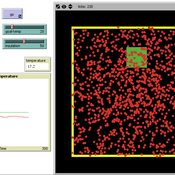
Thermostat II
María Pereda Jesús M Zamarreño | Published Thursday, June 12, 2014 | Last modified Monday, June 16, 2014A thermostat is a device that allows to have the temperature in a room near a desire value.
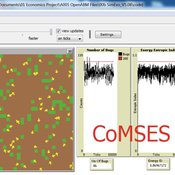
00b SimEvo_V5.08 NetLogo
Garvin Boyle | Published Saturday, October 05, 2019In 1985 Dr Michael Palmiter, a high school teacher, first built a very innovative agent-based model called “Simulated Evolution” which he used for teaching the dynamics of evolution. In his model, students can see the visual effects of evolution as it proceeds right in front of their eyes. Using his schema, small linear changes in the agent’s genotype have an exponential effect on the agent’s phenotype. Natural selection therefore happens quickly and effectively. I have used his approach to managing the evolution of competing agents in a variety of models that I have used to study the fundamental dynamics of sustainable economic systems. For example, here is a brief list of some of my models that use “Palmiter Genes”:
- ModEco - Palmiter genes are used to encode negotiation strategies for setting prices;
- PSoup - Palmiter genes are used to control both motion and metabolic evolution;
- TpLab - Palmiter genes are used to study the evolution of belief systems;
- EffLab - Palmiter genes are used to study Jevon’s Paradox, EROI and other things.
…
EMMIT (Extendable Model for Malaria Intervention Testing)
Jacob Heintzelman Greg R Madey | Published Thursday, May 27, 2021EMMIT is an end-user developed agent-based simulation of malaria transmission. The simulation’s development is a case study demonstrating an approach for non-technical investigators to easily develop useful simulations of complex public health problems. We focused on malaria transmission, a major global public health problem, and insecticide resistance (IR), a major problem affecting malaria control. Insecticides are used to reduce transmission of malaria caused by the Plasmodium parasite that is spread by the Anopheles mosquito. However, the emergence and spread of IR in a mosquito population can diminish the insecticide’s effectiveness. IR results from mutations that produce behavioral changes or biochemical changes (such as detoxification enhancement, target site alterations) in the mosquito population that provide resistance to the insecticide. Evolutionary selection for the IR traits reduces the effectiveness of an insecticide favoring the resistant mosquito population. It has been suggested that biopesticides, and specifically those that are Late Life Acting (LLA), could address this problem. LLA insecticides exploit Plasmodium’s approximate 10-day extrinsic incubation period in the mosquito vector, a delay that limits malaria transmission to older infected mosquitoes. Since the proposed LLA insecticide delays mosquito death until after the exposed mosquito has a chance to produce several broods of offspring, reducing the selective pressure for resistance, it delays IR development and gives the insecticide longer effectivity. Such insecticides are designed to slow the evolution of IR thus maintaining their effectiveness for malaria control. For the IR problem, EMMIT shows that an LLA insecticide could work as intended, but its operational characteristics are critical, primarily the mean-time-to-death after exposure and the associated standard deviation. We also demonstrate the simulation’s extensibility to other malaria control measures, including larval source control and policies to mitigate the spread of IR. The simulation was developed using NetLogo as a case study of a simple but useful approach to public health research.
epiworldR Type: Fast Agent-Based Epi Models
George G. Vega Yon Derek Meyer | Published Monday, August 26, 2024A flexible framework for Agent-Based Models (ABM), the ‘epiworldR’ package provides methods for prototyping disease outbreaks and transmission models using a ‘C++’ backend, making it very fast. It supports multiple epidemiological models, including the Susceptible-Infected-Susceptible (SIS), Susceptible-Infected-Removed (SIR), Susceptible-Exposed-Infected-Removed (SEIR), and others, involving arbitrary mitigation policies and multiple-disease models. Users can specify infectiousness/susceptibility rates as a function of agents’ features, providing great complexity for the model dynamics. Furthermore, ‘epiworldR’ is ideal for simulation studies featuring large populations.
Peer reviewed Organizational behavior in the hierarchy model
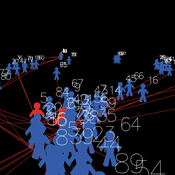
Smarzhevskiy Ivan | Published Tuesday, June 18, 2019 | Last modified Wednesday, July 31, 2019In a two-level hierarchical structure (consisting of the positions of managers and operators), persons holding these positions have a certain performance and the value of their own (personal perception in this, simplified, version of the model) perception of each other. The value of the perception of each other by agents is defined as a random variable that has a normal distribution (distribution parameters are set by the control elements of the interface).
In the world of the model, which is the space of perceptions, agents implement two strategies: rapprochement with agents that perceive positively and distance from agents that perceive negatively (both can be implemented, one of these strategies, or neither, the other strategy, which makes the agent stationary). Strategies are implemented in relation to those agents that are in the radius of perception (PerRadius).
The manager (Head) forms a team of agents. The performance of the group (the sum of the individual productivities of subordinates, weighted by the distance from the leader) varies depending on the position of the agents in space and the values of their individual productivities. Individual productivities, in the current version of the model, are set as a random variable distributed evenly on a numerical segment from 0 to 100. The manager forms the team 1) from agents that are in (organizational) radius (Op_Radius), 2) among agents that the manager perceives positively and / or negatively (both can be implemented, one of the specified rules, or neither, which means the refusal of the command formation).
Agents can (with a certain probability, given by the variable PrbltyOfDecisn%), in case of a negative perception of the manager, leave his group permanently.
It is possible in the model to change on the fly radii values, update the perception value across the entire population and the perception of an individual agent by its neighbors within the perception radius, and the probability values for a subordinate to make a decision about leaving the group.
You can also change the set of strategies for moving agents and strategies for recruiting a team manager. It is possible to add a randomness factor to the movement of agents (Stoch_Motion_Speed, the default is set to 0, that is, there are no random movements).
…
NetLogo HIV spread model
Wouter Vermeer | Published Friday, October 25, 2019This model describes the tranmission of HIV by means of unprotected anal intercourse in a population of men-who-have-sex-with-men.
The model is parameterized based on field data from a cohort study conducted in Atlanta Georgia.
Knowledge Based Economy
Guido Fioretti Sirio Capizzi Ruggero Rossi Martina Casari Ala Jlif | Published Tuesday, May 18, 2021Knowledge Based Economy (KBE) is an artificial economy where firms placed in geographical space develop original knowledge, imitate one another and eventually recombine pieces of knowledge. In KBE, consumer value arises from the capability of certain pieces of knowledge to bridge between existing items (e.g., Steve Jobs illustrated the first smartphone explaining that you could make a call with it, but also listen to music and navigate the Internet). Since KBE includes a mechanism for the generation of value, it works without utility functions and does not need to model market exchanges.
Population Dynamics of Emerald Ash Borer
mpeters | Published Monday, December 13, 2010 | Last modified Saturday, April 27, 2013This model was developed as part of a class project, and explores the population dynamics and spread of an invasive insect, Emerald Ash Borer, in a county.
Polarization
Grant Eads | Published Tuesday, November 30, 2021A model depicting how individuals change political opinions and are influenced by others with similar opinions, and how those people form into groupings. We also model the impact that a large amount of unchanging, automatic agents impact the established groupings
Space colonization
allagonne | Published Wednesday, January 05, 2022Agent-Based-Modeling - space colonization
ask me for the .nlogo model
WHAT IS IT?
The goal of this project is to simulate with NetLogo (v6.2) a space colonization of humans, starting from Earth, into the Milky Way.
HOW IT WORKS
…
Displaying 10 of 1139 results for "J A Cuesta" clear search