Our mission is to help computational modelers develop, document, and share their computational models in accordance with community standards and good open science and software engineering practices. Model authors can publish their model source code in the Computational Model Library with narrative documentation as well as metadata that supports open science and emerging norms that facilitate software citation, computational reproducibility / frictionless reuse, and interoperability. Model authors can also request private peer review of their computational models. Models that pass peer review receive a DOI once published.
All users of models published in the library must cite model authors when they use and benefit from their code.
Please check out our model publishing tutorial and feel free to contact us if you have any questions or concerns about publishing your model(s) in the Computational Model Library.
Displaying 10 of 1024 results for "Rolf Anker Ims" clear search
Benchmark for FLAME Agent-based modeling and simulation (ABMS) platform
Andreu Moreno Vendrell Josep Jorba Eduardo César Anna Sikora | Published Friday, November 22, 2024Agent-based modeling and simulation (ABMS) is a class of computational models for simulating the actions and interactions of autonomous agents with the goal of assessing their effects on a system as a whole. Several frameworks for generating parallel ABMS applications have been developed taking advantage of their common characteristics, but there is a lack of a general benchmark for comparing the performance of generated applications. We propose and design a benchmark that takes into consideration the most common characteristics of this type of applications and includes parameters for influencing their relevant performance aspects. We provide an initial implementation of the benchmark for FLAME one of the most popular parallel ABMS platforms, and we use it for comparing the applications generated by these platforms.
Peer reviewed CapOvCWD
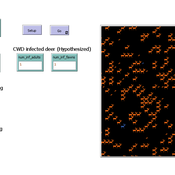
Aniruddha Belsare | Published Tuesday, September 09, 2025 | Last modified Tuesday, November 11, 2025CapOvCWD is an agent-based model that simulates a captive cervid herd composed of adults and fawns. The model deer population is initialized using data on herd size and composition from captive facility records. Individual deer domiciliary history and annual CWD testing records inform the herd size and sample size (for CWD testing), respectively. The model can be used to iteratively estimate the facility level annual CWD detection probability. Detection probability estimates can be further refined by incorporating multiyear CWD testing data. This approach can be particularly useful for interpreting negative test results from a subset of the captive herd. Facility level detection probability estimates provide a comprehensive and standardized risk metric that reflects the likelihood of undetected CWD in the facility.
Agent Based Simulation of Technology Adoption
Moeed Haghnevis | Published Tuesday, December 07, 2010 | Last modified Saturday, April 27, 2013The purpose of this model is to study effect of a particular kind of spatial externality, “fashion effect”, on the dynamics of technology diffusion among rational adopters with uncertainty about the p
SimAdapt
François Rebaudo | Published Wednesday, August 29, 2012 | Last modified Monday, October 13, 2014SimAdapt: An individual-based genetic model for simulating landscape management impacts on populations
CA_Assiut_v1.0
Nina Schwarz Yang Chen m-m-abdelkader Mahmood Abdelkader | Published Sunday, October 09, 2022The purpose of the model is to simulate the future growth of human settlements in the Nile river valley in Egypt. The model contains processes to mimic spatial patterns found in the case study region.
A simulation of the structure of academic science
Nigel Gilbert | Published Friday, December 31, 2010 | Last modified Saturday, April 27, 2013This is a re-implementation of the model described in Gilbert, Nigel. (1997). A simulation of the structure of academic science. Sociological Research Online, 2(2)3, http://www.socresonline.org.uk/
Peer reviewed MOOvPOP
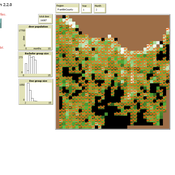
Matthew Gompper Aniruddha Belsare Joshua J Millspaugh | Published Monday, April 10, 2017 | Last modified Saturday, April 19, 2025MOOvPOP is designed to simulate population dynamics (abundance, sex-age composition and distribution in the landscape) of white-tailed deer (Odocoileus virginianus) for a selected sampling region.
A Balance Model of Opinion Hyperpolarization
Simon Schweighofer Frank Schweitzer David Garcia Simon Schweighofer | Published Tuesday, December 17, 2019 | Last modified Tuesday, December 17, 2019Contains python3 code to replicate the opinion dynamics model from our (so far unpublished) JASSS sumbission “A Balance Model of Opinion Hyperpolarization”. The main function is run_model(), which returns a dictionary object containing various outcome metrics.
Peer reviewed Horse population dynamics
Nika Galic | Published Tuesday, November 12, 2013 | Last modified Wednesday, October 29, 2014This model investigates the link between prescribed growth in body size, population dynamics and density dependence through population feedback on available resources.
Demographic microsimulation for individuals and couples
Sabine Zinn | Published Wednesday, January 14, 2015The simulation model conducts fine-grained population projection by specifying life course dynamics of individuals and couples by means of traditional demographic microsimulation and by using agent-based modeling for mate matching.
Displaying 10 of 1024 results for "Rolf Anker Ims" clear search