Our mission is to help computational modelers develop, document, and share their computational models in accordance with community standards and good open science and software engineering practices. Model authors can publish their model source code in the Computational Model Library with narrative documentation as well as metadata that supports open science and emerging norms that facilitate software citation, computational reproducibility / frictionless reuse, and interoperability. Model authors can also request private peer review of their computational models. Models that pass peer review receive a DOI once published.
All users of models published in the library must cite model authors when they use and benefit from their code.
Please check out our model publishing tutorial and feel free to contact us if you have any questions or concerns about publishing your model(s) in the Computational Model Library.
Displaying 10 of 160 results for "Russell Toth" clear search
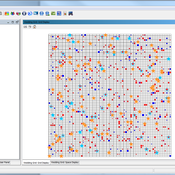
Wedding Doughnut
Eric Silverman Jason Hilton Jakub Bijak Viet Cao | Published Thursday, December 20, 2012 | Last modified Friday, September 20, 2013A reimplementation of the Wedding Ring model by Francesco Billari. We investigate partnership formation in an agent-based framework, and combine this with statistical demographic projections using real empirical data.
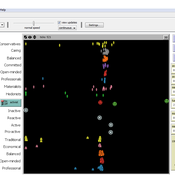
Food supply chain innovations under public pressure
Tim Verwaart Wil Hennen Jan Buurma | Published Friday, April 15, 2016 | Last modified Tuesday, November 27, 2018Aroused public opinion has led to public debates on social responsibility issues in food supply chains. This model based op opinion dynamics and the linkages between involved actors simulates the public debate leading to the transitions.
Simulation of the Effects of Disorganization on Goals and Problem Solving
Dinuka Herath | Published Sunday, August 13, 2017 | Last modified Sunday, August 13, 2017This is a model of the occurrence of disorganization and its impact on individual goal setting and problem-solving. This model therefore, explores the effects of disorganization on goal achievement.
Simulating the evolution of the human family
Paul Smaldino | Published Wednesday, November 29, 2017The (cultural) evolution of cooperative breeding in harsh environments.

Mitigating bioenergy-driven biodiversity decline: a modelling approach with the European brown hare
Volker Grimm Maria Langhammer | Published Wednesday, November 13, 2019 | Last modified Tuesday, November 24, 2020The model is designed to analyse the effects of mitigation measures on the European brown hare (Lepus europaeus), which is directly affected by ongoing land use change and has experienced widespread decline throughout Europe since the 1960s. As an input, we use two 4×4 km large model landscapes, which were generated by a landscape generator based on real field sizes and crop proportions and differed in average field size and crop composition. The crops grown annually are evaluated in terms of forage suitability, breeding suitability and crop richness for the hare. Six mitigation scenarios are implemented, defined by a 10 % increase in: (1) mixed silphie, (2) miscanthus, (3) grass-clover ley, (4) alfalfa, (5) set-aside, and (6) general crop richness. The model shows that that both landscape configuration and composition have a significant effect on hare population development, which responds particularly strongly to compositional changes.
The Travel-tour case study
Christophe Sibertin-Blanc Françoise Adreit Joseph El Gemayel | Published Sunday, May 19, 2013 | Last modified Friday, June 14, 2013This model describes and analyses the Travel-Tour Case study.
An agent-based model of cultural change for a low-carbon transition
Daniel Torren-Peraire | Published Friday, November 10, 2023An ABM of changes in individuals’ lifestyles which considers their
evolving behavioural choices. Individuals have a set of environmental behavioural traits that spread through a fixed Watts–Strogatz graph via social interactions with their neighbours. These exchanges are mediated by transmission biases informing from whom an individual learns and
how much attention is paid. The influence of individuals on each other is a function of their similarity in environmental identity, where we represent environmental identity computationally by aggregating past agent attitudes towards multiple environmentally related behaviours. To perform a behaviour, agents must both have
a sufficiently positive attitude toward a behaviour and overcome a corresponding threshold. This threshold
structure, where the desire to perform a behaviour does not equal its enactment, allows for a lack of coherence
between attitudes and actual emissions. This leads to a disconnect between what people believe and what
…
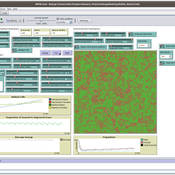
Peer reviewed Mission Cattle
Isaac Ullah | Published Monday, December 15, 2025The model examines cattle herd dynamics on a patchy grassland subject to two exogenous pressures: periodic raiding events that remove animals and scheduled management culling that can target males and/or females. It is intended for comparative experiments on how raiding frequency, culling schedules, vegetation dynamics, and life-history parameters interact to shape herd persistence. The model was specifically designed to test the scenario of cattle herding in the arid grasslands of southern Arizona and northern Sonora during the mission period (late 17th through late 18th centuries, CE). In this period, herds were locally managed by Spanish mission personnel and local O’odham groups. Herds were culled mostly for local consumption of meat, hides, and tallow, but the mission herds were often targets for raiding by neighboring groups. The main purpose of the model is to examine herd dynamics in a seasonally variable, arid environment where herds are subject to both intentional internal harvest (culling) and external harvest (raiding).
Peak-seeking Adder
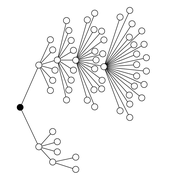
Julia Kasmire Janne M Korhonen | Published Tuesday, December 02, 2014 | Last modified Friday, February 20, 2015Continuing on from the Adder model, this adaptation explores how rationality, learning and uncertainty influence the exploration of complex landscapes representing technological evolution.
EthnoCultural Tag model (ECT)
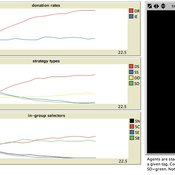
Bruce Edmonds David Hales | Published Friday, October 16, 2015 | Last modified Wednesday, May 09, 2018Captures interplay between fixed ethnic markers and culturally evolved tags in the evolution of cooperation and ethnocentrism. Agents evolve cultural tags, behavioural game strategies and in-group definitions. Ethnic markers are fixed.
Displaying 10 of 160 results for "Russell Toth" clear search