Our mission is to help computational modelers develop, document, and share their computational models in accordance with community standards and good open science and software engineering practices. Model authors can publish their model source code in the Computational Model Library with narrative documentation as well as metadata that supports open science and emerging norms that facilitate software citation, computational reproducibility / frictionless reuse, and interoperability. Model authors can also request private peer review of their computational models. Models that pass peer review receive a DOI once published.
All users of models published in the library must cite model authors when they use and benefit from their code.
Please check out our model publishing tutorial and feel free to contact us if you have any questions or concerns about publishing your model(s) in the Computational Model Library.
Displaying 10 of 100 results empirical clear search
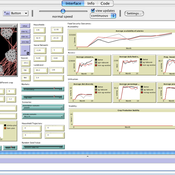
A Model to Unravel the Complexity of Rural Food Security
Stefano Balbi Samantha Dobbie | Published Monday, August 22, 2016 | Last modified Sunday, December 02, 2018An ABM to simulate the behaviour of households within a village and observe the emerging properties of the system in terms of food security. The model quantifies food availability, access, utilisation and stability.
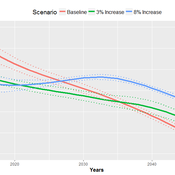
Multistate modeling extended by behavioral rules
Frans Willekens Sabine Zinn Matthias Leuchter Anna Klabunde | Published Wednesday, August 03, 2016 | Last modified Tuesday, March 13, 2018Toolkit to specify demographic multistate model with a behavioural element linking intentions to behaviour
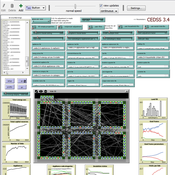
CEDSS is an agent-based model of domestic energy demand at the level of a small community.
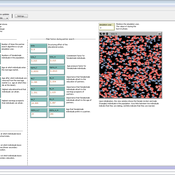
A model to explore the link between the gender-gap reversal in education and relative divorce risks
Jan Van Bavel Christine Schnor André Grow | Published Thursday, June 30, 2016 | Last modified Wednesday, September 13, 2017This model explores a social mechanism that links the reversal of the gender gap in education with changing patterns in relative divorce risks in 12 European countries.
Opinions on contested energy infrastructures
Annalisa Stefanelli | Published Thursday, June 23, 2016This ABM simulates opinions on a topic (originally contested infrastructures) through the interactions between paired agents and based on the sociopsychological assumptions of social judgment theory (SJT; Sherif & Hovland, 1961).

THE STATUS ARENA
Gert Jan Hofstede Jillian Student Mark R Kramer | Published Wednesday, June 08, 2016 | Last modified Tuesday, January 09, 2018Status-power dynamics on a playground, resulting in a status landscape with a gender status gap. Causal: individual (beauty, kindness, power), binary (rough-and-tumble; has-been-nice) or prior popularity (status). Cultural: acceptability of fighting.

SimPLS - The PLS Agent
Iris Lorscheid Sandra Schubring Matthias Meyer Christian Ringle | Published Monday, April 18, 2016 | Last modified Tuesday, May 17, 2016The simulation model SimPLS shows an application of the PLS agent concept, using SEM as empirical basis for the definition of agent architectures. The simulation model implements the PLS path model TAM about the decision of using innovative products.
Endogenous dynamics of firms made up by networked agents: an exploratory analysis
Bernardo Alves Furtado Isaque Daniel Rocha Eberhardt | Published Wednesday, March 23, 2016 | Last modified Wednesday, October 05, 2016This is an adaptation and extension of Robert Axtell’s model (2013) of endogenous firms, in Python 3.4
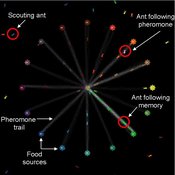
Composite Collective Decision Making - ant colony foraging model
Tomer Czaczkes Benjamin I Czaczkes | Published Thursday, December 17, 2015The model explores how two types of information - social (in the form of pheromone trails) and private (in the form of route memories) affect ant colony level foraging in a variable enviroment.
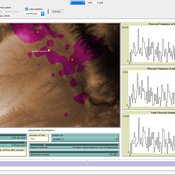
Charcoal Record Simulation Model (CharRec)
Grant Snitker | Published Monday, November 16, 2015 | Last modified Thursday, September 30, 2021This model (CharRec) creates simulated charcoal records, based on differing natural and anthropogenic patterns of ignitions, charcoal dispersion, and deposition.
Displaying 10 of 100 results empirical clear search