Our mission is to help computational modelers develop, document, and share their computational models in accordance with community standards and good open science and software engineering practices. Model authors can publish their model source code in the Computational Model Library with narrative documentation as well as metadata that supports open science and emerging norms that facilitate software citation, computational reproducibility / frictionless reuse, and interoperability. Model authors can also request private peer review of their computational models. Models that pass peer review receive a DOI once published.
All users of models published in the library must cite model authors when they use and benefit from their code.
Please check out our model publishing tutorial and feel free to contact us if you have any questions or concerns about publishing your model(s) in the Computational Model Library.
Displaying 10 of 977 results for "Ibo van de Poel" clear search
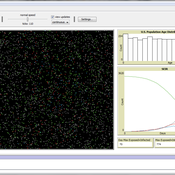
COVID-19 US Masks
Dale Brearcliffe | Published Sunday, October 18, 2020This model is an abstract simulation of the COVID-19 virus in the United States population. It demonstrates how different masks of different types affect the progress of the virus.
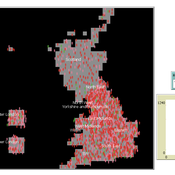
Identity and meat eating behaviour
Jiaqi Ge | Published Thursday, September 29, 2022Using data from the British Social Attitude Survey, we develop an agent-based model to study the effect of social influence on the spread of meat-eating behaviour in the British population.
A formalized implementation of Halstead and O’Shea’s Bad Year Economics. The agent population uses one of four resilience strategies in an attempt to cope with a dynamic environment of stresses and shocks.
FilterBubbles_in_Carley1991
Benoît Desmarchelier | Published Wednesday, May 21, 2025The model is an extension of: Carley K. (1991) “A theory of group stability”, American Sociological Review, vol. 56, pp. 331-354.
The original model from Carley (1991) works as follows:
- Agents know or ignore a series of knowledge facts;
- At each time step, each agent i choose a partner j to interact with at random, with a probability of choice proportional to the degree of knowledge facts they have in common.
- Agents interact synchronously. As such, interaction happens only if the partnert j is not already busy interacting with someone else.
…
Schwartz Human Values and the Economic Performance
Marcin Czupryna Bogumił Kamiński | Published Wednesday, November 29, 2023The purpose of the model is to provide an analogy for how the Schwartz values may influence the aggregated economic performance, as measured by: public goods provision, private goods provision and leisure time.
Ageing and Spending
Tony Lawson | Published Tuesday, October 06, 2015How natural population ageing affects UK household spending patterns.
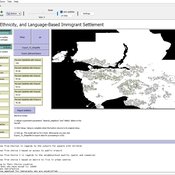
Geospatial Agent-Based Model of Immigrant Settlement Dynamics in Metro Vancouver
Liliana Perez Navid Mahdizadeh Gharakhanlou Maryam Yousefi | Published Wednesday, December 03, 2025This agent-based model simulates how new immigrant households choose where to live in Metro Vancouver under the origins diversity scenario. The model begins with 16,000 household agents, reflecting an expected annual population increase of about 42,500 people based on an average household size of 2.56. Each agent is assigned four characteristics: one of ten origin categories, income level (adjusted using NOC data and recent immigrant earnings), likelihood of having children, and preferred mode of commuting. The ten origin groups are drawn from Census patterns, including six subgroups within the broader Asian category (China, India, the Philippines, Iran, South Korea, and Other Asian countries) and two categories for immigrants from the Americas. This refined classification better captures the diversity of newcomers arriving in the region.
Community Forest Management with Monitoring and Sanctioning
Maya Lapp Colby Long | Published Wednesday, April 29, 2020 | Last modified Friday, July 23, 2021This NetLogo ABM builds on Elena Vallino’s model of Loggers using community-based natural resource management for a forest ecosystem. In it we introduce an alternative mechanism for Logger cheating and enforcement of CBNRM rules.

Software for an agent-based game-theoretic model of the contact hypothesis of prejudice reduction, to accompany “Modeling Prejudice Reduction,” in the Handbook of Computational Social Psychology, adapted from Public Affairs Quarterly 19 (2) 2005.
Police funding: legitimacy and hardship
Jack Mitcham | Published Sunday, February 27, 2022An extension of Epstein’s (2002) model for civil violence and Fonoberova et al’s (2012) extension of Epstein’s model. Uses heterogeneous hardship values and dynamic legitimacy values. Models public funding decisions between police and social welfare.
Displaying 10 of 977 results for "Ibo van de Poel" clear search