Our mission is to help computational modelers develop, document, and share their computational models in accordance with community standards and good open science and software engineering practices. Model authors can publish their model source code in the Computational Model Library with narrative documentation as well as metadata that supports open science and emerging norms that facilitate software citation, computational reproducibility / frictionless reuse, and interoperability. Model authors can also request private peer review of their computational models. Models that pass peer review receive a DOI once published.
All users of models published in the library must cite model authors when they use and benefit from their code.
Please check out our model publishing tutorial and feel free to contact us if you have any questions or concerns about publishing your model(s) in the Computational Model Library.
Displaying 10 of 246 results for "Paulien Herder" clear search
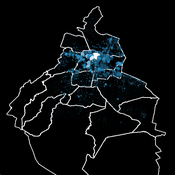
Socio-hydrologicalModel_version_SESMO
Marco Janssen Andres Baeza-Castro Paola Gomez Luis Bojorquez Fidel Serrano-Candela Hallie Eakin Yosune Miquelajauregui Rodrigo Garcia-Herrera | Published Tuesday, February 05, 2019We present here MEGADAPT_SESMO model. A hybrid, dynamic, spatially explicit, integrated model to simulate the vulnerability of urban coupled socio-ecological systems – in our case, the vulnerability of Mexico City to socio-hydrological risk.
Socio-spatial segregation in Salzburg, Austria
Andreas Koch | Published Friday, September 25, 2009 | Last modified Saturday, April 27, 2013This is a first preliminary simulation model to model segregation in the city of Salzburg, Austria.
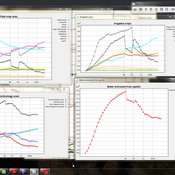
A model of groundwater usage by farmers in the Upper Guadiana, Spain
Georg Holtz | Published Thursday, June 30, 2011 | Last modified Saturday, April 27, 2013An agent-based model to investigate the history of irrigated agriculture in the Upper Guadiana Basin, Spain, in order to learn about the influence of farmers’ characteristics (inter alia profit orientation, risk aversion, skills, available labour force and farm size) on land-use change and associated groundwater over-use in this region.
Agent-based model of repeated conservation auctions in low-income countries
Sebastian Rasch Elsa Cardona Hugo Storm | Published Sunday, March 22, 2020Our model allows simulating repeated conservation auctions in low-income countries. It is designed to assess policy-making by exploring the extent to which non-targeted repeated auctions can provide biodiversity conservation cost-effectively, while alleviating poverty. Targeting landholders in order to integrate both goals is claimed to be overambitious and underachieving because of the trade-offs they imply. The simulations offer insight on the possible outcomes that can derive from implementing conservation auctions in low-income countries, where landholders are likely to be risk averse and to face uncertainty.
Agent-based simulation of discussion processes in risk workshops with quantitative skepticism
Matthias Meyer Clemens Harten Lucia Bellora-Bienengräber | Published Sunday, August 14, 2022The model measures drivers of effectiveness of risk assessments in risk workshops where a calculative culture of quantitative skepticism is present. We model the limits to information transfer, incomplete discussions, group characteristics, and interaction patterns and investigate their effect on risk assessment in risk workshops, in order to contrast results to a previous model focused on a calculative culture of quantitative enthusiasm.
The model simulates a discussion in the context of a risk workshop with 9 participants. The participants use constraint satisfaction networks to assess a given risk individually and as a group.
Peer reviewed Emergent Firms Model
J M Applegate | Published Friday, July 13, 2018The Emergent Firm (EF) model is based on the premise that firms arise out of individuals choosing to work together to advantage themselves of the benefits of returns-to-scale and coordination. The Emergent Firm (EF) model is a new implementation and extension of Rob Axtell’s Endogenous Dynamics of Multi-Agent Firms model. Like the Axtell model, the EF model describes how economies, composed of firms, form and evolve out of the utility maximizing activity on the part of individual agents. The EF model includes a cash-in-advance constraint on agents changing employment, as well as a universal credit-creating lender to explore how costs and access to capital affect the emergent economy and its macroeconomic characteristics such as firm size distributions, wealth, debt, wages and productivity.
Replicating the Macy & Sato Model: Trust, Cooperation and Market Formation in the U.S. and Japan
Oliver Will | Published Saturday, August 29, 2009 | Last modified Saturday, April 27, 2013A replication of the model “Trust, Cooperation and Market Formation in the U.S. and Japan” by Michael W. Macy and Yoshimichi Sato.

Eixample-MAS Traffic Simulation
Àlex Pardo Fernandez David Sánchez Pinsach | Published Tuesday, January 22, 2013 | Last modified Saturday, April 27, 2013This MAS simulates the traffic of Barcelona Eixample. Uses a centralized AI system in order to control the traffic lights. Car agents are reactive and have no awareness of the intelligence of the system. They (try to) avoid collisions.
This is the R code of the mathematical model that includes the decision making formulations for artificial agents. Plus, the code for graphical output is also added to the original code.
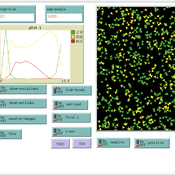
Simulation of Dual Information Exposure Networks: An Agent-Based Model of Panic Buying Behavior in China
dachenga | Published Thursday, April 11, 2024The main function of this simulation model is to simulate the onset of individual panic in the context of a public health event, and in particular to simulate how an individual’s panic develops and dies out in the context of a dual information contact network of online social media information and offline in-person perception information. In this model, eight different scenarios are set up by adjusting key parameters according to the difference in the amount and nature of information circulating in the dual information network, in order to observe how the agent’s panic behavior will change under different information exposure situations.
Displaying 10 of 246 results for "Paulien Herder" clear search