Our mission is to help computational modelers develop, document, and share their computational models in accordance with community standards and good open science and software engineering practices. Model authors can publish their model source code in the Computational Model Library with narrative documentation as well as metadata that supports open science and emerging norms that facilitate software citation, computational reproducibility / frictionless reuse, and interoperability. Model authors can also request private peer review of their computational models. Models that pass peer review receive a DOI once published.
All users of models published in the library must cite model authors when they use and benefit from their code.
Please check out our model publishing tutorial and feel free to contact us if you have any questions or concerns about publishing your model(s) in the Computational Model Library.
Displaying 10 of 187 results for "Robin D Fink" clear search
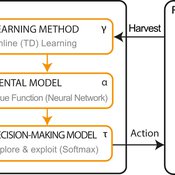
LBD Model: Learning-by-doing for sustainable management of renewable resources
Emilie Lindkvist Örjan Ekeberg Jon Norberg | Published Thursday, March 09, 2017This is a simulation model of an intelligent agent that has the objective to learn sustainable management of a renewable resource, such as a fish stock.
Generalized Trust in the Mirror - a model on the Dynamics of Trust
Dominik Klein Johannes Marx | Published Friday, January 12, 2018This model studies the emergence and dynamics of generalized trust. It does so by modeling agents that engage in trust games and, based on their experience, slowly determine whether others are, in general, trustworthy.
Emergence of Small-World Networks in an Overlapping-Generations Model of Social Dynamics, Trust and Economic Performance
Bogumił Kamiński Jakub Growiec Katarzyna Growiec | Published Thursday, February 27, 2020We study the impact of endogenous creation and destruction of social ties in an artificial society on aggregate outcomes such as generalized trust, willingness to cooperate, social utility and economic performance. To this end we put forward a computational multi-agent model where agents of overlapping generations interact in a dynamically evolving social network. In the model, four distinct dimensions of individuals’ social capital: degree, centrality, heterophilous and homophilous interactions, determine their generalized trust and willingness to cooperate, altogether helping them achieve certain levels of social utility (i.e., utility from social contacts) and economic performance. We find that the stationary state of the simulated social network exhibits realistic small-world topology. We also observe that societies whose social networks are relatively frequently reconfigured, display relatively higher generalized trust, willingness to cooperate, and economic performance – at the cost of lower social utility. Similar outcomes are found for societies where social tie dissolution is relatively weakly linked to family closeness.
Peer review model with heterogeneous grade language
Pablo Lucas Thomas Feliciani Ramanathan Moorthy Kalpana Shankar | Published Thursday, May 07, 2020This ABM re-implements and extends the simulation model of peer review described in Squazzoni & Gandelli (Squazzoni & Gandelli, 2013 - doi:10.18564/jasss.2128) (hereafter: ‘SG’). The SG model was originally developed for NetLogo and is also available in CoMSES at this link.
The purpose of the original SG model was to explore how different author and reviewer strategies would impact the outcome of a journal peer review system on an array of dimensions including peer review efficacy, efficiency and equality. In SG, reviewer evaluation consists of a continuous variable in the range [0,1], and this evaluation scale is the same for all reviewers. Our present extension to the SG model allows to explore the consequences of two more realistic assumptions on reviewer evaluation: (1) that the evaluation scale is discrete (e.g. like in a Likert scale); (2) that there may be differences among their interpretation of the grades of the evaluation scale (i.e. that the grade language is heterogeneous).
The Evolution of Multiple Resistant Strains: An Abstract Model of Systemic Treatment and Accumulated Resistance
Benjamin Nye | Published Wednesday, August 31, 2011 | Last modified Saturday, April 27, 2013This model is intended to explore the effectiveness of different courses of interventions on an abstract population of infections. Illustrative findings highlight the importance of the mechanisms for variability and mutation on the effectiveness of different interventions.
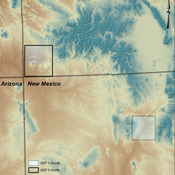
Village Ecodynamics Project
ipem | Published Friday, May 13, 2011 | Last modified Saturday, April 27, 2013The Village Project is designed to help archaeologists understand the factors influencing settlement patterns of small-scale agrarian peoples. Although such societies are becoming increasingly rare, they represent the norm throughout most of the Neolithic period the world over.
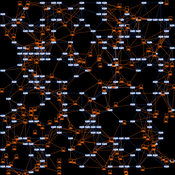
Modeling financial networks based on interpersonal trust
Michael Roos Anna Klabunde | Published Wednesday, May 29, 2013 | Last modified Thursday, November 28, 2013We build a stylized model of a network of business angel investors and start-up entrepreneurs. Decisions are based on trust as a decision making tool under true uncertainty.
Parental choices, children's skills, and skill inequality: An agent-based model implemented in Python
Andrés Cardona | Published Thursday, October 30, 2014The model explores the emergence of inequality in cognitive and socio-emotional skills at the societal level within and across generations that results from differences in parental investment behavior during childhood and adolescence.
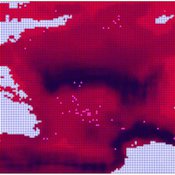
HomininSpace
Fulco Scherjon | Published Friday, November 25, 2016 | Last modified Tuesday, October 06, 2020A modelling system to simulate Neanderthal demography and distribution in a reconstructed Western Europe for the late Middle Paleolithic.

RaMDry - Rangeland Model in Drylands
Pascal Fust Eva Schlecht | Published Friday, January 05, 2018 | Last modified Friday, April 01, 2022RaMDry allows to study the dynamic use of forage ressources by herbivores in semi-arid savanna with an emphasis on effects of change of climate and management. Seasonal dynamics affects the amount and the nutritional values of the available forage.
Displaying 10 of 187 results for "Robin D Fink" clear search