Our mission is to help computational modelers develop, document, and share their computational models in accordance with community standards and good open science and software engineering practices. Model authors can publish their model source code in the Computational Model Library with narrative documentation as well as metadata that supports open science and emerging norms that facilitate software citation, computational reproducibility / frictionless reuse, and interoperability. Model authors can also request private peer review of their computational models. Models that pass peer review receive a DOI once published.
All users of models published in the library must cite model authors when they use and benefit from their code.
Please check out our model publishing tutorial and feel free to contact us if you have any questions or concerns about publishing your model(s) in the Computational Model Library.
Displaying 10 of 1137 results for "Elena A. Pearce" clear search
Sensitivity of the Deffuant model to measurement error
Dino Carpentras | Published Monday, June 07, 2021This code can be used to analyze the sensitivity of the Deffuant model to different measurement errors. Specifically to:
- Intrinsic stochastic error
- Binning of the measurement scale
- Random measurement noise
- Psychometric distortions
…
Peer reviewed JuSt-Social COVID-19
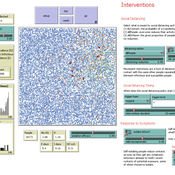
Jennifer Badham | Published Thursday, June 18, 2020 | Last modified Monday, March 29, 2021NetLogo model that allows scenarios concerning general social distancing, shielding of high-risk individuals, and informing contacts when symptomatic. Documentation includes a user manual with some simple scenarios, and technical information including descriptions of key procedures and parameter values.
Peer reviewed Social Consequences of Past Compound Events - Laacher See Eruption
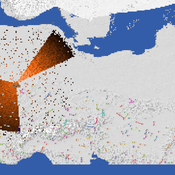
Kevin Su Brennen Bouwmeester | Published Monday, May 17, 2021Resilience of humans in the Upper Paleolithic could provide insights in how to defend against today’s environmental threats. Approximately 13,000 years ago, the Laacher See volcano located in present-day western Germany erupted cataclysmically. Archaeological evidence suggests that this is eruption – potentially against the background of a prolonged cold spell – led to considerable culture change, especially at some distance from the eruption (Riede, 2017). Spatially differentiated and ecologically mediated effects on contemporary social networks as well as social transmission effects mediated by demographic changes in the eruption’s wake have been proposed as factors that together may have led to, in particular, the loss of complex technologies such as the bow-and-arrow (Riede, 2014; Riede, 2009).
This model looks at the impact of the interaction between climate change trajectory and an extreme event, such as the Laacher See eruption, on the generational development of hunter-gatherer bands. Historic data is used to model the distribution and population dynamics of hunter-gatherer bands during these circumstances.
Behavioural model
Aulia Imania Sukma | Published Friday, November 07, 2025This repository serves as a design proof for agent-based modeling simulation in heat adaptation behavior. This model was developed as part of the UrbanAir project theme. This repository will be kept updated in the four-year timeline (2025 until 2029).
Sunshine or Shield?: Secret Voting Procedures and Legislative Accountability
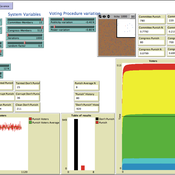
Matthew Taylor Michele Buttò Carlos Pereira | Published Tuesday, June 24, 2014 | Last modified Monday, April 08, 2019An agent-based model is used to simulate legislators’ behavior under secret voting rules, as influenced by the power of the accused politician, the composition of the voting body, and the publicity of the accusations.
Network structures tutorial
Tom Brughmans | Published Sunday, September 30, 2018 | Last modified Tuesday, October 02, 2018A draft model with some useful code for creating different network structures using the Netlogo NW extension. This model is used for the following tutorial:
Brughmans, T. (2018). Network structures and assembling code in Netlogo, Tutorial, https://archaeologicalnetworks.wordpress.com/resources/#structures .
Samambaia Basin - Hydro-ABM
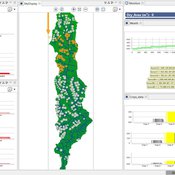
Pedro Phelipe Gonçalves Porto | Published Sunday, April 07, 2019 | Last modified Monday, May 06, 2019This model is a tool to support water management on Samambaia Basin. On it you can explore different scenarios of policy, management and externalities that could influence the water uses. (Scenarios already tested include less rain and payment on water use)
Pastoralscape
Matthew Sottile | Published Tuesday, October 12, 2021Pastoralscape is a model of human agents, lifestock health and contageous disease for studying the impact of human decision making in pastoral communities within East Africa on livestock populations. It implements an event-driven agent based model in Python 3.
The Epistemic Role of Diversity in Juries
Aaron Bramson Patrick Grim Daniel J Singer Jiin Jung William J. Berger Bennett Holman | Published Wednesday, August 16, 2023This model is linked to the paper “The Epistemic Role of Diversity in Juries: An Agent-Based Model”. There are many version of this model, but the current version focuses on the role of diversity in whether juries reach correct verdicts. Using this agent-based model, we argue that diversity can play at least four importantly different roles in affecting jury verdicts. (1) Where different subgroups have access to different information, equal representation can strengthen epistemic jury success. (2) If one subgroup has access to particularly strong evidence, epistemic success may demand participation by that group. (3) Diversity can also reduce the redundancy of the information on which a jury focuses, which can have a positive impact. (4) Finally, and most surprisingly, we show that limiting communication between diverse groups in juries can favor epistemic success as well.

Agent-based modeling of the spatio-temporal distribution of Sahelian transhumant herds
Cheick Amed Diloma Gabriel TRAORE Etienne DELAY Alassane Bah Djibril Diop | Published Tuesday, May 20, 2025Sahelian transhumance is a seasonal pastoral mobility between the transhumant’s terroir of origin and one or more host terroirs. Sahelian transhumance can last several months and extend over hundreds of kilometers. Its purpose is to ensure efficient and inexpensive feeding of the herd’s ruminants. This paper describes an agent-based model to determine the spatio-temporal distribution of Sahelian transhumant herds and their impact on vegetation. Three scenarios based on different values of rainfall and the proportion of vegetation that can be grazed by transhumant herds are simulated. The results of the simulations show that the impact of Sahelian transhumant herds on vegetation is not significant and that rainfall does not impact the alley phase of transhumance. The beginning of the rainy season has a strong temporal impact on the spatial distribution of transhumant herds during the return phase of transhumance.
Displaying 10 of 1137 results for "Elena A. Pearce" clear search