Our mission is to help computational modelers develop, document, and share their computational models in accordance with community standards and good open science and software engineering practices. Model authors can publish their model source code in the Computational Model Library with narrative documentation as well as metadata that supports open science and emerging norms that facilitate software citation, computational reproducibility / frictionless reuse, and interoperability. Model authors can also request private peer review of their computational models. Models that pass peer review receive a DOI once published.
All users of models published in the library must cite model authors when they use and benefit from their code.
Please check out our model publishing tutorial and feel free to contact us if you have any questions or concerns about publishing your model(s) in the Computational Model Library.
Displaying 10 of 1129 results for "Bin-Tzong Chi" clear search
Urban waterlogging disaster evaluation based on complex network a case study of Zhengzhou, China
Chao Ding Jia Xu | Published Monday, April 17, 2023The model constructs a complex network of traffic based on the main urban area of Zhengzhou, China, and simulates the urban rainfall process using the ABM model to analyse the real-time risk of flooding hazards in the nodes of the complex network.
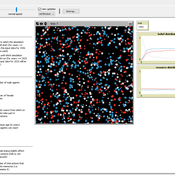
Peer reviewed Modelling the Social Complexity of Reputation and Status Dynamics
André Grow Andreas Flache | Published Wednesday, February 01, 2017 | Last modified Wednesday, January 23, 2019The purpose of this model is to illustrate the use of agent-based computational modelling in the study of the emergence of reputation and status beliefs in a population.
Landscape connectivity and predator–prey population dynamics
Jacopo A. Baggio | Published Thursday, November 10, 2011 | Last modified Saturday, April 27, 2013A simple model to assess the effect of connectivity on interacting species (i.e. predator-prey type)
OLIGO
Mason Wright | Published Thursday, October 24, 2013 | Last modified Monday, April 08, 2019A multi-agent model of oligarchy in a spatial election simulation.
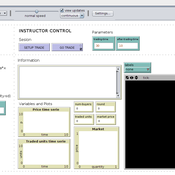
Quality uncertainty and market failure
David Poza José Manuel Galán María Pereda José Santos | Published Wednesday, May 14, 2014 | Last modified Wednesday, April 25, 2018Quality uncertainty and market failure: an interactive model to conduct classroom experiments
Alternative Fuel Design/Consumer Choice Model
Rosanna Garcia | Published Wednesday, September 22, 2010 | Last modified Saturday, April 27, 2013This is a model of the diffusion of alternative fuel vehicles based on manufacturer designs and consumer choices of those designs. It is written in Netlogo 4.0.3. Because it requires data to upload
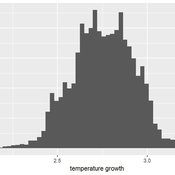
Agent Based Integrated Assessment Model
Marcin Czupryna | Published Saturday, June 27, 2020Agent based approach to the class of the Integrated Assessment Models. An agent-based model (ABM) that focuses on the energy sector and climate relevant facts in a detailed way while being complemented with consumer goods, labour and capital markets to a minimal necessary extent.
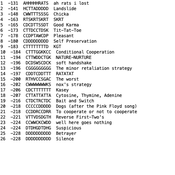
Prisoner's Tournament
Kristin Crouse | Published Wednesday, November 06, 2019 | Last modified Wednesday, December 15, 2021This model replicates the Axelrod prisoner’s dilemma tournaments. The model takes as input a file of strategies and pits them against each other to see who achieves the best payoff in the end. Change the payoff structure to see how it changes the tournament outcome!
Peer reviewed PrioritEvac: An Agent-Based Model of Evacuation from Building Fires
Eileen Young | Published Friday, December 06, 2019This simulation is of the 2003 Station Nightclub Fire and is part of the Interdependencies in Community Resilience (ICoR) project (http://www-personal.umich.edu/~eltawil/icor.html). The git contains the simulation as well as csvs of data about the fire, smoke, building, and people involved.
Wolf-sheep predation Netlogo model, extended, with foresight
Guido Fioretti Andrea Policarpi | Published Wednesday, September 16, 2020 | Last modified Tuesday, April 13, 2021This model is an extension of the Netlogo Wolf-sheep predation model by U.Wilensky (1997). This extended model studies several different behavioural mechanisms that wolves and sheep could adopt in order to enhance their survivability, and their overall impact on global equilibrium of the system.
Displaying 10 of 1129 results for "Bin-Tzong Chi" clear search