Computational Model Library

LogoClim: WorldClim in NetLogo (2.0.0)

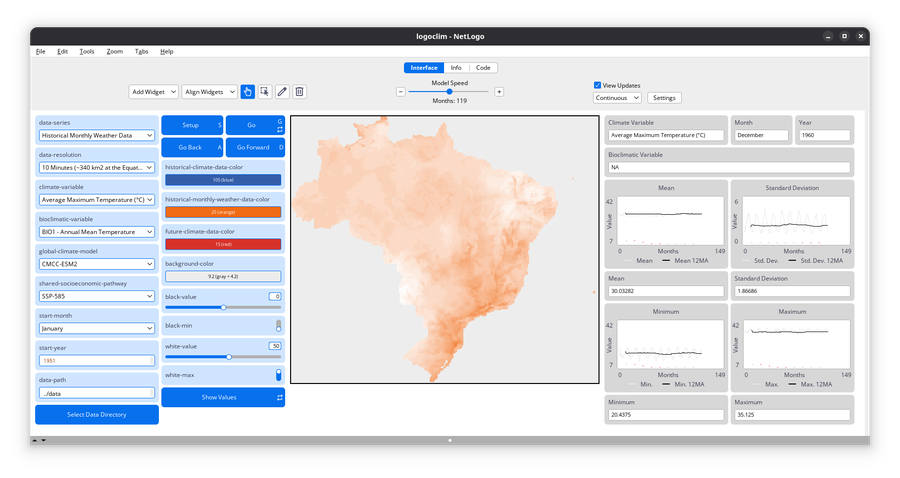
LogoClim is a NetLogo model for simulating and visualizing global climate conditions. It allows researchers to integrate high-resolution climate data into agent-based models, supporting reproducible research in ecology, agriculture, environmental sciences, and other fields that rely on climate data.

The model utilizes raster data to represent climate variables such as temperature and precipitation over time. It incorporates historical data (1951-2024) and future climate projections (2021-2100) derived from global climate models under various Shared Socioeconomic Pathways (SSPs, O’Neill et al., 2017). All climate inputs come from WorldClim 2.1, a widely used source of high-resolution, interpolated climate datasets based on weather station observations worldwide (Fick & Hijmans, 2017).

LogoClim follows the FAIR Principles for Research Software (Barker et al., 2022) and is openly available on the CoMSES Network and GitHub. See the Logônia model for an example of its integration into a full NetLogo simulation.
1.png

Release Notes

  • Updated the model for compatibility with NetLogo 7.0.0.
  • Resized interface widgets to match the new NetLogo standard dimensions.
  • Changed the LogoClim license from MIT to GPLv3.
  • Removed the transition-seconds slider, as it is no longer necessary.
  • Removed the adjust-world-size? slider; world size adjustment is now always enabled by default.
  • Introduced the global variable plot-max-y-range to optimize computations.
  • Revised documentation to reflect updates.

Associated Publications

A manuscript describing the model has been submitted to the Journal of Open Source Software (JOSS) and is currently under review.

This release is out-of-date. The latest version is 2.1.0

LogoClim: WorldClim in NetLogo 2.0.0

LogoClim is a NetLogo model for simulating and visualizing global climate conditions. It allows researchers to integrate high-resolution climate data into agent-based models, supporting reproducible research in ecology, agriculture, environmental sciences, and other fields that rely on climate data.

The model utilizes raster data to represent climate variables such as temperature and precipitation over time. It incorporates historical data (1951-2024) and future climate projections (2021-2100) derived from global climate models under various Shared Socioeconomic Pathways (SSPs, O’Neill et al., 2017). All climate inputs come from WorldClim 2.1, a widely used source of high-resolution, interpolated climate datasets based on weather station observations worldwide (Fick & Hijmans, 2017).

LogoClim follows the FAIR Principles for Research Software (Barker et al., 2022) and is openly available on the CoMSES Network and GitHub. See the Logônia model for an example of its integration into a full NetLogo simulation.

Release Notes

  • Updated the model for compatibility with NetLogo 7.0.0.
  • Resized interface widgets to match the new NetLogo standard dimensions.
  • Changed the LogoClim license from MIT to GPLv3.
  • Removed the transition-seconds slider, as it is no longer necessary.
  • Removed the adjust-world-size? slider; world size adjustment is now always enabled by default.
  • Introduced the global variable plot-max-y-range to optimize computations.
  • Revised documentation to reflect updates.

Version Submitter First published Last modified Status
2.1.0 Daniel Vartanian Tue Sep 16 05:25:45 2025 Mon Sep 29 20:33:55 2025 Published
2.0.0 Daniel Vartanian Mon Aug 4 22:58:14 2025 Mon Sep 29 20:33:30 2025 Published
1.0.0 Daniel Vartanian Thu Jul 3 10:02:19 2025 Mon Sep 29 20:33:29 2025 Published
0.0.0 Daniel Vartanian Thu Jul 3 02:30:24 2025 Mon Sep 29 20:33:29 2025 Published

Discussion

This website uses cookies and Google Analytics to help us track user engagement and improve our site. If you'd like to know more information about what data we collect and why, please see our data privacy policy. If you continue to use this site, you consent to our use of cookies.
Accept