Computational Model Library

Driving in the wrong direction? Modelling policy mixes for EV adoption (1.0.1)

Car-centric societies face challenges in transitioning to sustainable mobility,
with electric vehicle adoption depending on the interaction of consumer behaviour,
firm innovation, and policy incentives. To examine these dynamics, we develop an
agent-based model calibrated on California data from 2001–2023. Heterogeneous
consumers influence each other in their acceptance of EVs, while manufacturers
incorporate these changes into their innovation and product-mix strategies. We
evaluate individual and combined policy instruments, including carbon pricing,
new and used purchase rebates, production subsidies, and electricity price subsidies. Results show that only carbon pricing and new vehicle purchase rebates
achieve 95% electric vehicle adoption by 2035. Each policy has trade-offs: carbon
pricing reduces consumer welfare, while new purchase rebates create heavy fiscal
burdens. Policy combinations reduce the intensity of interventions and transitional
costs, while mitigating trade-offs. By 2050, combinations of carbon price and subsidies yield 30% reductions in cumulative emissions against the business-as-usual
scenario.
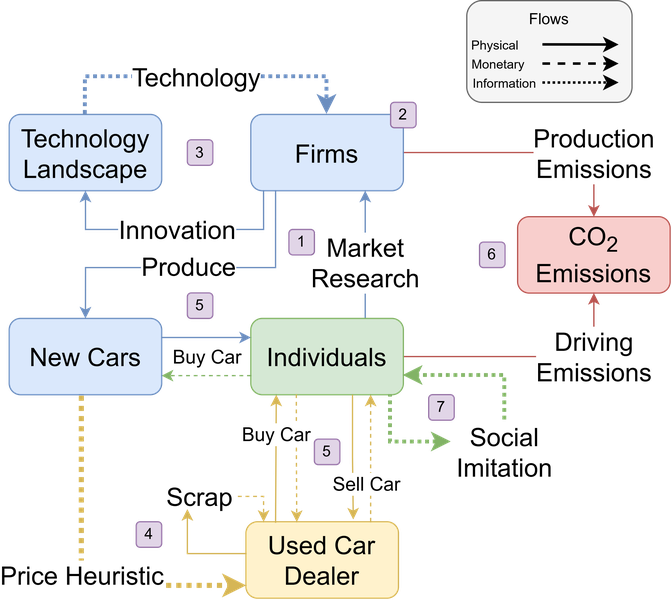
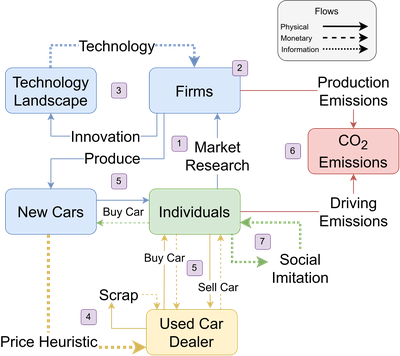
Figure_1.png

Release Notes

Updated the code and image

Associated Publications

Driving in the wrong direction? Modelling policy mixes for EV adoption 1.0.1

Car-centric societies face challenges in transitioning to sustainable mobility,
with electric vehicle adoption depending on the interaction of consumer behaviour,
firm innovation, and policy incentives. To examine these dynamics, we develop an
agent-based model calibrated on California data from 2001–2023. Heterogeneous
consumers influence each other in their acceptance of EVs, while manufacturers
incorporate these changes into their innovation and product-mix strategies. We
evaluate individual and combined policy instruments, including carbon pricing,
new and used purchase rebates, production subsidies, and electricity price subsidies. Results show that only carbon pricing and new vehicle purchase rebates
achieve 95% electric vehicle adoption by 2035. Each policy has trade-offs: carbon
pricing reduces consumer welfare, while new purchase rebates create heavy fiscal
burdens. Policy combinations reduce the intensity of interventions and transitional
costs, while mitigating trade-offs. By 2050, combinations of carbon price and subsidies yield 30% reductions in cumulative emissions against the business-as-usual
scenario.

Release Notes

Updated the code and image

Version Submitter First published Last modified Status
1.0.1 Daniel Torren-Peraire Wed Aug 5 13:23:56 2026 Wed Aug 5 13:26:49 2026 Published
1.0.0 Daniel Torren-Peraire Fri Jul 11 12:04:51 2025 Wed Aug 5 13:26:21 2026 Published

Discussion

This website uses cookies and Google Analytics to help us track user engagement and improve our site. If you'd like to know more information about what data we collect and why, please see our data privacy policy. If you continue to use this site, you consent to our use of cookies.
Accept