Our mission is to help computational modelers develop, document, and share their computational models in accordance with community standards and good open science and software engineering practices. Model authors can publish their model source code in the Computational Model Library with narrative documentation as well as metadata that supports open science and emerging norms that facilitate software citation, computational reproducibility / frictionless reuse, and interoperability. Model authors can also request private peer review of their computational models. Models that pass peer review receive a DOI once published.
All users of models published in the library must cite model authors when they use and benefit from their code.
Please check out our model publishing tutorial and feel free to contact us if you have any questions or concerns about publishing your model(s) in the Computational Model Library.
Displaying 10 of 337 results for "John Nay" clear search

Peer reviewed Visibility of archaeological social networks
Claudine Gravel-Miguel | Published Sunday, November 26, 2023The purpose of this model is to explore the impact of combining archaeological palimpsests with different methods of cultural transmission on the visibility of prehistoric social networks. Up until recently, Paleolithic archaeologists have relied on stylistic similarities of artifacts to reconstruct social networks. However, this method - which is successfully applied to more recent ceramic assemblages - may not be applicable to Paleolithic assemblages, as several of those consist of palimpsests of occupations. Therefore, this model was created to study how palimpsests of occupation affect our social network reconstructions.
The model simplifies inter-groups interactions between populations who share cultural traits as they produce artifacts. It creates a proxy archaeological record of artifacts with stylistic traits that can then be used to reconstruct interactions. One can thus use this model to compare the networks reconstructed through stylistic similarities with direct contact.
HyperMu’NmGA - Effect of Hypermutation Cycles in a NetLogo Minimal Genetic Algorithm
Cosimo Leuci | Published Tuesday, October 27, 2020 | Last modified Sunday, July 31, 2022A minimal genetic algorithm was previously developed in order to solve an elementary arithmetic problem. It has been modified to explore the effect of a mutator gene and the consequent entrance into a hypermutation state. The phenomenon seems relevant in some types of tumorigenesis and in a more general way, in cells and tissues submitted to chronic sublethal environmental or genomic stress.
For a long time, some scholars suppose that organisms speed up their own evolution by varying mutation rate, but evolutionary biologists are not convinced that evolution can select a mechanism promoting more (often harmful) mutations looking forward to an environmental challenge.
The model aims to shed light on these controversial points of view and it provides also the features required to check the role of sex and genetic recombination in the mutator genes diffusion.
The Epistemic Role of Diversity in Juries
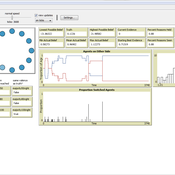
Aaron Bramson Patrick Grim Daniel J Singer Jiin Jung William J. Berger Bennett Holman | Published Wednesday, August 16, 2023This model is linked to the paper “The Epistemic Role of Diversity in Juries: An Agent-Based Model”. There are many version of this model, but the current version focuses on the role of diversity in whether juries reach correct verdicts. Using this agent-based model, we argue that diversity can play at least four importantly different roles in affecting jury verdicts. (1) Where different subgroups have access to different information, equal representation can strengthen epistemic jury success. (2) If one subgroup has access to particularly strong evidence, epistemic success may demand participation by that group. (3) Diversity can also reduce the redundancy of the information on which a jury focuses, which can have a positive impact. (4) Finally, and most surprisingly, we show that limiting communication between diverse groups in juries can favor epistemic success as well.
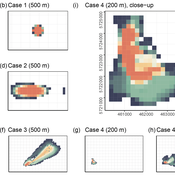
The Agent-Based Wildfire Simulation Environment (ABWiSE) translates the concept of a moving fire front as a set of mobile fire agents that respond to, and interact with, vegetation, wind, and terrain. Presently, the purpose of ABWiSE is to explore how ABM, using simple interactions between agents and a simple atmospheric feedback model, can simulate emergent fire spread patterns.
The dynamic agent-based model of market of single commodity and process of setting of prices
Mark Voronovitsky | Published Saturday, January 24, 2009 | Last modified Saturday, April 27, 2013The dynamic agent based model of system which turn out the self-adjusting system, are considered in this text.
Activation Regimes in Opinion Dynamics
Meysam Alizadeh Claudio Cioffi-Revilla | Published Tuesday, September 01, 2015We compare the effect of four activation regimes by measuring the appropriate opinion clustering statistics and also the number of emergent extremists.
Kulayinjana
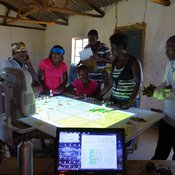
Christophe Le Page Arthur Perrotton Michel De Garine-Wichatitsky Barry Bitu Killion Koyisi Ferdinand Mwamba Cephus Ncube Victor Ncube Siphusisiwe Ndlovu Raphael Ngwenya Ambu Nyathi Fumbane Nyathi Patrick Sibanda Zenzo Sibanda | Published Monday, October 03, 2016a computer-based role-playing game simulating the interactions between farming activities, livestock herding and wildlife in a virtual landscape reproducing local socioecological dynamics at the periphery of Hwange National Park (Zimbabwe).
Institutional change
Abigail Sullivan | Published Friday, October 07, 2016 | Last modified Sunday, December 02, 2018This model builds on another model in this library (“diffusion of culture”).
Simulation of the Effects of Disorganization on Goals and Problem Solving
Dinuka Herath | Published Sunday, August 13, 2017 | Last modified Sunday, August 13, 2017This is a model of the occurrence of disorganization and its impact on individual goal setting and problem-solving. This model therefore, explores the effects of disorganization on goal achievement.
High Standards Enhance Inequality in Idealized Labor Markets
Károly Takács | Published Tuesday, March 20, 2018Takács, K. and Squazzoni, F. 2015. High Standards Enhance Inequality in Idealized Labor Markets. Journal of Artificial Societies and Social Simulation, 18(4), 2, http://jasss.soc.surrey.ac.uk/18/4/2.html
We built a simple model of an idealized labor market, in which there is no objective difference in average quality between groups and hiring decisions are not biased in favor of any particular group. Our results show that inequality in employment emerges necessarily also in such idealized situations due to the limited supply of high quality individuals and asymmetric information. Inequalities are exacerbated when employers have high standards and keep only the best workers in house. We found that ambitious workers get higher quality jobs even if ambition does not correlate or even negatively correlates with internal quality. Our findings help to corroborate empirical findings on higher employment discrepancies in high rather than low status jobs.
Displaying 10 of 337 results for "John Nay" clear search