Our mission is to help computational modelers develop, document, and share their computational models in accordance with community standards and good open science and software engineering practices. Model authors can publish their model source code in the Computational Model Library with narrative documentation as well as metadata that supports open science and emerging norms that facilitate software citation, computational reproducibility / frictionless reuse, and interoperability. Model authors can also request private peer review of their computational models. Models that pass peer review receive a DOI once published.
All users of models published in the library must cite model authors when they use and benefit from their code.
Please check out our model publishing tutorial and feel free to contact us if you have any questions or concerns about publishing your model(s) in the Computational Model Library.
Displaying 10 of 1195 results for "Aad Kessler" clear search
Endogenous Corruption as a Cellular Automaton
Warren Vierheller | Published Wednesday, June 27, 2018The model explores how corruption may spread endogenously within a closed society by depicting the behavior within a cellular automaton context (CA) between bureaucrats and citizens. Within the model, corruption is characterized as a behavior product dependent upon an individual’s personal disposition towards honesty, rational decisionmaking processes, and neighbors’ behavior.
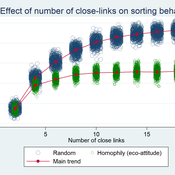
Waste separation in small-world networks
František Kalvas Michaela Kudrnáčová | Published Monday, September 30, 2019The model answers the question how homophily and number of close-links in small-world network influences behavior of consumats. The results show that the more close-links the more probable the consumat follows the major behavior, but homophilly blocks the major behavior and supports survival of the minor behavior.
WeDiG Sim
Reza Shamsaee | Published Monday, May 14, 2012 | Last modified Saturday, April 27, 2013WeDiG Sim- Weighted Directed Graph Simulator - is an open source application that serves to simulate complex systems. WeDiG Sim reflects the behaviors of those complex systems that put stress on scale-free, weightedness, and directedness. It has been implemented based on “WeDiG model” that is newly presented in this domain. The WeDiG model can be seen as a generalized version of “Barabási-Albert (BA) model”. WeDiG not only deals with weighed directed systems, but also it can handle the […]

Swidden farming by individual households
C Michael Barton | Published Sunday, April 27, 2008 | Last modified Saturday, April 27, 2013Swidden Farming is designed to explore the dynamics of agricultural land management strategies.
ManPraSim: A Management Practice Simulation
peer-olaf_siebers | Published Wednesday, February 23, 2011 | Last modified Saturday, April 27, 2013This simulation model is associated with the journal paper “A First Approach on Modelling Staff Proactiveness in Retail Simulation Models” to appear in the Journal of Artificial Societies and Social Simulation 14 (2) 2. The authors are Peer-Olaf Siebers ([email protected]) and Uwe Aickelin ([email protected]).
CRESY-I stands for CREativity from a SYstems perspetive, Model I. This is the base model in a series designed to describe a systems approach to creativity in terms of variation, selection and retention (VSR) subprocesses.
Environmental uncertainty affects the optimal structure of information-sharing networks
Marco Janssen Takao Sasaki Zachary Joseph Shaffer Stephen Pratt | Published Monday, March 16, 2015We used a computer simulation to measure how well different network structures (fully connected, small world, lattice, and random) find and exploit resource peaks in a variable environment.
Influence with over-confident agents
Juliette Rouchier Emily Tanimura | Published Wednesday, October 21, 2015Agents can influence each other if they are close enough in knowledge. The probability to convince with good knowledge and number of agents have an impact on the dissemination of knowledge.

The PARSO_demo Model
Davide Secchi | Published Tuesday, November 05, 2019This model explores different aspects of the formation of urban neighbourhoods where residents believe in values distant from those dominant in society. Or, at least, this is what the Danish government beliefs when they discuss their politics about parallel societies. This simulation is set to understand (a) whether these alternative values areas form and what determines their formation, (b) if they are linked to low or no income residents, and (c) what happens if they disappear from the map. All these three points are part of the Danish government policy. This agent-based model is set to understand the boundaries and effects of this policy.
Introduction of a contact tracking app for outbreak control
Tim Verwaart | Published Tuesday, April 21, 2020The application of a smartphone application to register physical encounters between individuals is considered by public health authorities, as a means to reduce the number of infections in the 2020 COVID-19 pandemic. The general idea is that continuous registration of all other smartphones in the vicinity of an individual’s smartphone potentially enables early warning of the owners of the other smartphones, in case the individual is tested positive as infected. Those other individuals can then go into isolation and be considered for testing. The purpose of the present simulation is to explore the potential effects of this application on frequencies of infection, isolation, and positive and negative infection test results.
Displaying 10 of 1195 results for "Aad Kessler" clear search